
This device has no English text-to-speech voice, so the article may not be read aloud.
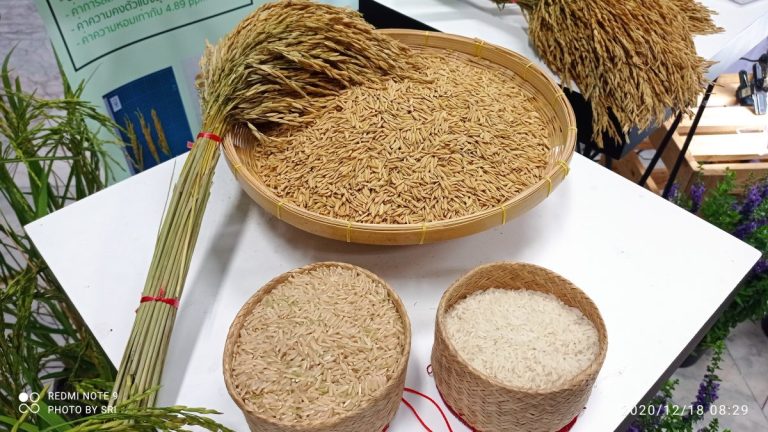
Hom Jinda rice, a Thai non-glutinous rice line, is one of the competitive opportunities for Thai farmers, with outstanding features of fragrant, soft grains, resistance to bacterial leaf blight, strong stems that do not lodge easily, and medium height.
Genetic diversity has been a topic of interest among scientists and researchers worldwide for more than a decade, because research results can be built on commercially and can increase competitiveness from the local to the international level.
Thailand is one of the countries producing several million tons of agricultural products a year. The most widely grown economic crops in Thailand are rice, sugarcane, rubber and cassava, issues on which Thailand's agricultural agencies have devoted effort and funding to raise quality and yield, leading to competitive opportunities in the world market and making products more distinctive and attractive.
Thailand's most important economic crop, grown in every region, is rice, so many agencies conduct research on rice growing. The National Center for Genetic Engineering and Biotechnology (BIOTEC), NSTDA, is one of the agencies that has done rice variety research for more than 10 years.
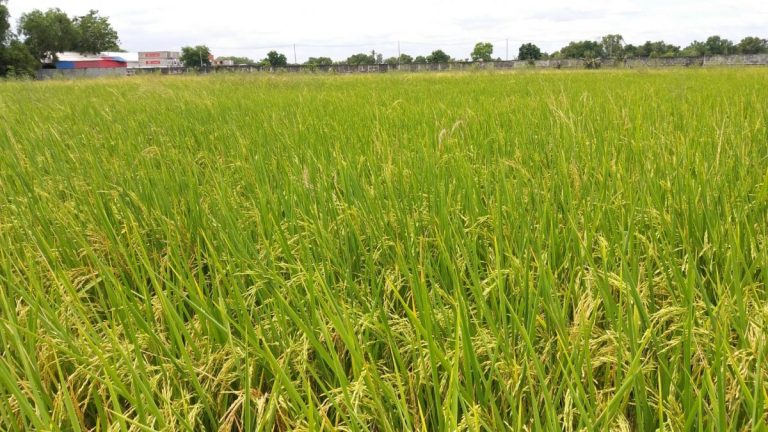
A farmer's trial plot where Hom Jinda non-glutinous rice was grown on trial BIOTEC focuses on applying biotechnology to breeding important economic crops such as rice to meet farmers' needs, for example Hom Naka glutinous rice, Hom Jinda non-glutinous rice and Thanya 6401 non-glutinous rice. BIOTEC works with public and private partner agencies on field trials and satisfaction evaluation with farmers, a working model that lets farmers and consumers take part in selecting good, suitable rice varieties to scale up planting in the area.
In 2021, BIOTEC is preparing Hom Jinda rice, a non-glutinous rice obtained by conventional crossing between the Pathum Thani variety as the female parent and the line RGD07097-1-MAS-8-9-0-0 as the male parent.
“The outstanding features of this line are fragrant, soft grains, resistance to bacterial leaf blight, strong stems, flash-flood tolerance, resistance to lodging, medium height, and a high average yield of 838 kilograms per rai,” said Dr. Wonnop Visessanguan, Director of the National Center for Genetic Engineering and Biotechnology (BIOTEC), NSTDA.
Hom Jinda non-glutinous rice is being trialed in the experimental plots of the Ruamjai Phatthana Foundation and in farmers' plots in Suphan Buri and Nonthaburi provinces since 2019, and is expected to be developed into seed for farmers to grow within this year.
In addition, BIOTEC has also bred new tomato varieties, Daeng Komen and Sunshine, which are cherry tomatoes that are sweet and crisp, bear heavily, resist yellow leaf curl disease and give high yields, and have been registered with the Department of Agriculture. Working with Maejo University, the varieties are being transferred to seed companies for commercial development and to farmers for fresh produce production.
On products from BIOTEC developed with private companies and already in real use, Dr. Wonnop said that BIOTEC works with the private sector and has transferred production technology to many private companies, for example the new eLysozyme product for the shrimp feed industry, working with Ovo Foodtech Co., Ltd. and DMF (Thailand) Co., Ltd.
Beta-glucan and probiotic yeast products for livestock have been transferred to Asia Star Trade Co., Ltd. Fermented vinegar products (mangosteen juice, pineapple juice, coconut sugar, black garlic) are made with A&P Orchard 1959 Co., Ltd., Sin A Brew Co., Ltd., Thai Udom Food Industry Co., Ltd. and Nopada Products Co., Ltd.
Another interesting product is a new alternative protein from mushrooms, made with the Thai Rungruang Sugar Group (Lin sugar), and others. All these products have led to total investment of more than 180 million baht, and can generate income and greatly reduce imports of products from abroad.
In the future, competition in agriculture and food will focus on “essential nutrients”, so if we can prepare to meet this demand, we can raise the competitiveness of Thai farmers, Dr. Wonnop concluded.
Story: Naphatdanai. Photos: National Center for Genetic Engineering and Biotechnology (BIOTEC), NSTDA (https://www.biotec.or.th) Full article with photos and other interesting articles at https://ngthai.com/science/33782/homjinda