

This device has no English text-to-speech voice, so the article may not be read aloud.
BIOTEC, NSTDA Launches ‘Hom Naka’, a New Glutinous Rice Variety with Amphibious Properties Glutinous rice represents food security in northern and northeastern Thailand because it is the staple food of people there. But because of location and terrain, the Mekong basin fields face both floods and droughts in alternation, so they have rarely achieved yields equal to other, more fertile areas.
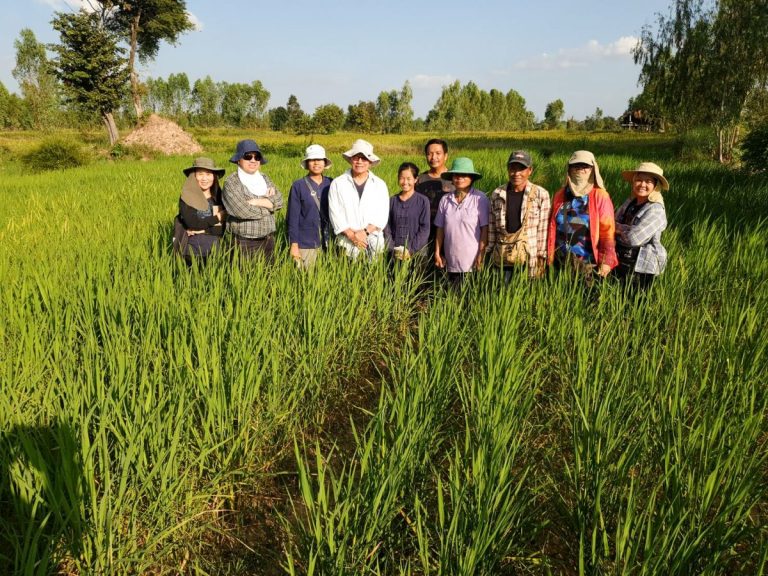
The National Science and Technology Development Agency (NSTDA), through the National Center for Genetic Engineering and Biotechnology (BIOTEC), together with Kasetsart University and Rajamangala University of Technology Lanna, developed ‘Hom Naka’ rice, a new glutinous rice variety tolerant of flash floods, drought and disease, which can be described as Thailand's first amphibious glutinous rice line.
Dr. Theerayut Toojinda Director of the Plant Biotechnology and Integrated Management Research Group, BIOTEC, NSTDA, said that the main problem farmers face in growing glutinous rice is lodging, because Thai glutinous rice varieties are tall, and in strong wind and rain the plants often fall over even before the panicles are fully developed. In a drought year, yields are often low. Farmers must also face blast and bacterial leaf blight, which stunt growth. These are the sorrows of rice farmers, whose fate hangs on risk factors they cannot control. Thai researchers have therefore been continuously trying to develop glutinous rice lines that overcome these problems.
Last year, BIOTEC, NSTDA, together with Mr. Srisawat Khantong and the research team, applied genetic engineering expertise to study and develop the genetics of Thai glutinous rice, promoting dominant genes and reducing recessive ones through appropriate crossing and selection, resulting in the new glutinous line “Hom Naka”, which can stay submerged for 1–2 weeks and tolerates water shortage at certain growth stages, suiting local conditions, and is also resistant to blast and bacterial leaf blight, the main causes of farmers' yield losses.
Hom Naka glutinous rice can be grown year-round because it is not photoperiod sensitive, in both the main season and off-season, with a growing period of about 130–140 days. It stands out for its short stem and easy harvesting, and can be harvested with labor-saving machines, in line with modern rice farming and the future trend of machines replacing manual work. In trial plantings, yields were 800–900 kg per rai in the north and as high as 700–800 kg per rai in the northeast, compared with the usual 400–500 kg per rai.
As for consumer response, Hom Naka glutinous rice is well liked because, when steamed, it is fragrant and soft, to the taste of Thai people. It also does not stick to the hands when eaten, does not harden when left standing, and does not turn mushy when reheated, which are outstanding qualities of this line.
Going forward, the research team aims to disseminate knowledge on seed development so that farmers can produce seed themselves, reducing dependence on the state or capitalists. On the trade side, the team has talked with rice mills about the strengths of this line so that they will buy it for resale, and the mills are quite interested. Dr. Theerayut said, adding that test results on processing show that the glutinous rice puffs well into puffed rice, so negotiations are under way for factories to try it as a raw material for processed foods.
Lastly, on the profit farmers will receive from selling the rice, the research team believes the price should be at the general market level to make buying and selling easy, because farmers' extra profit already comes from higher yield per crop and reduced use of pesticides and chemicals.
This glutinous rice development is an important achievement in applying science, technology and innovation to help the backbone of the nation overcome obstacles in farming amid unstable natural conditions.
Thanks to information from the National Science and Technology Development Agency (NSTDA) Images, the full article and other articles at https://ngthai.com/science/27782/homnakha