

This device has no English text-to-speech voice, so the article may not be read aloud.
Innovation Invention Description (the new, innovative part of the work)
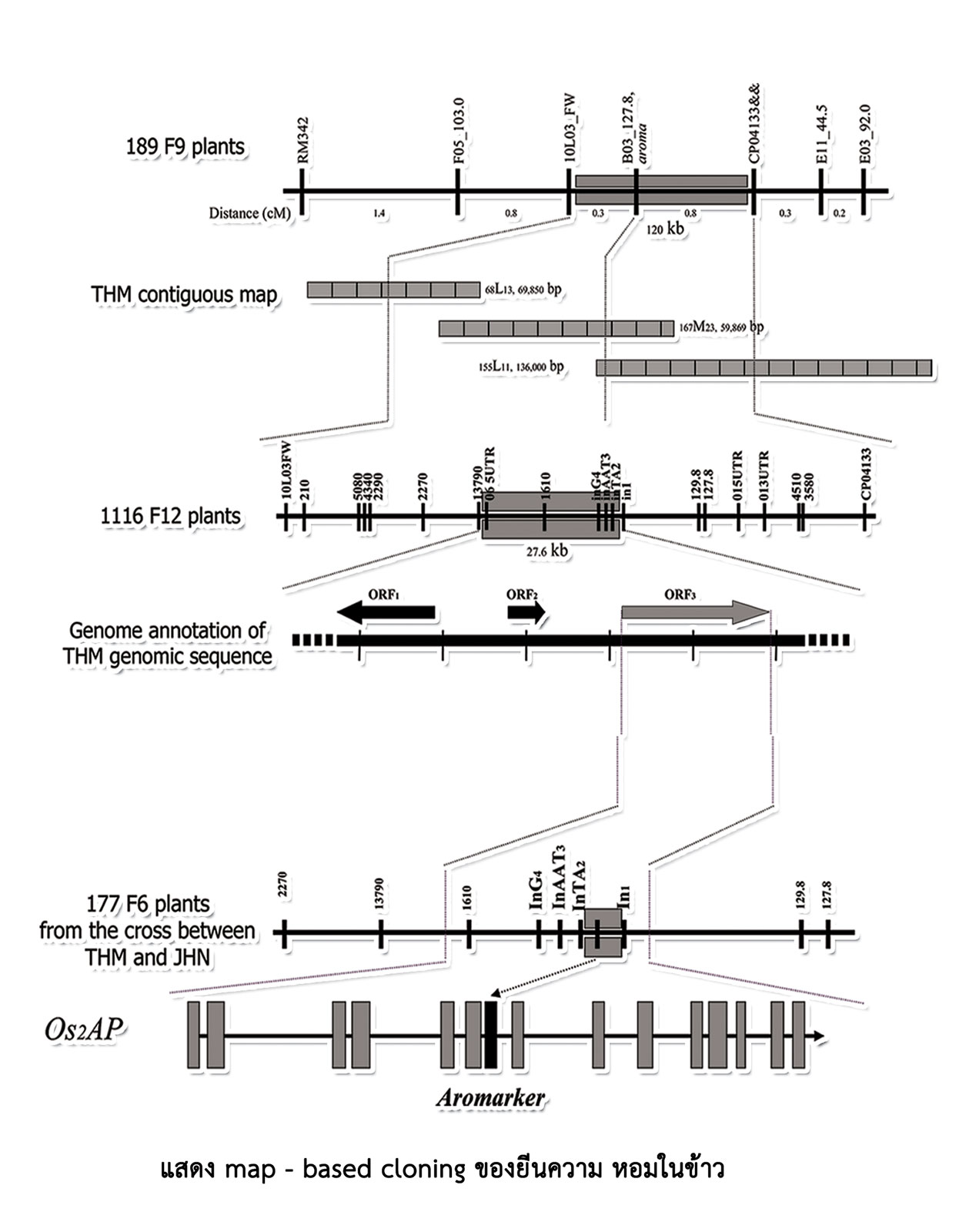
This invention concerns making plants accumulate 2AP, which was discovered in Khao Dawk Mali 105 rice by the map-based cloning technique, which is complex and takes a long time. The genetic material that causes plants to accumulate this aroma compound was found to be the gene that makes the protein controlling aroma in rice, called Os2AP (Oryza sativa 2-acetyl-1-pyrroline), a member of the amino aldehyde dehydrogenase (AMADH) family. In fragrant rice, this gene has a loss or gain of nucleic acids (insertion/deletion). RNA interference studies show that disrupting transcription of the Os2AP gene significantly raises the level of 2AP in the plant while also increasing aroma, whereas non-fragrant rice has a normally functioning Os2AP gene. Analysis of the 2AP synthesis pathway in rice found that the Os2AP gene converts the precursor 4-aminobutanol into the product gamma-aminobutyric acid (GABA). The invention presented here achieves its objectives in several ways. The first is to create any plant that can produce 2AP in its stems, leaves and seeds at levels higher than natural plants. In addition, the invention provides a method for accurately selecting plants with aroma traits in marker-assisted selection programs. The invention relates to making plants accumulate 2AP, the main aroma compound of fragrant rice, cereals, soybean and many fragrant flowers, and includes methods and genetic material that produce plants accumulating this aroma compound. The invention has developed plants that do not naturally accumulate 2AP so that they accumulate more, by inhibiting expression of the AMADH gene and/or the activity of the AMADH protein. The level of AMADH protein can be reduced by 25, 50 or 100 percent compared with control plants. Inhibiting expression of the AMADH gene can be done by: a) expressing fragments of the 2AP gene in the antisense direction; b) cloning part of the gene into an RNA interference construct and expressing this construct in transgenic plants; c) inducing mutations by various methods (including Targeting Induced Local Lesions IN Genomes (TILLING) and T-DNA insertion mutagenesis, followed by PCR screening for variation in aroma traits).
Importance/Background of the Innovation
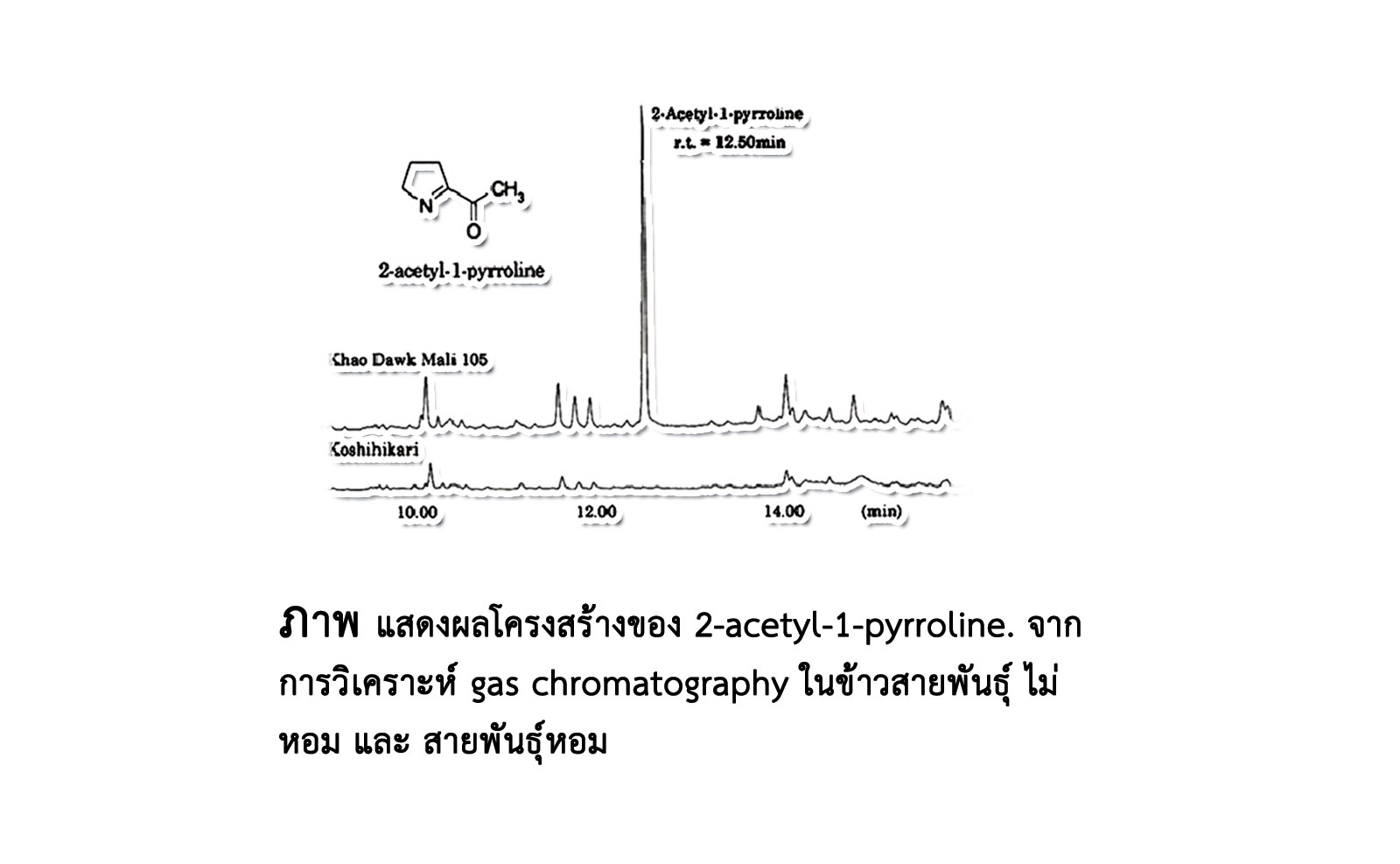
The compound 2-acetyl-1-pyrroline (2AP), or the "popcorn-like" aroma compound, was found to be the main aroma compound of all fragrant rice lines and of bread made from wheat and rye. 2AP is the main component of the aroma of many rice lines. Surprisingly, the aroma compound of rice is also found in pandan leaf, Pandanus-like flowers, wet millet, popcorn, Bacillus cereus and fungi. The aroma compound 2AP contains a pyrroline ring like the amino acid proline. The genetic material controlling gene expression that results in increased 2AP accumulation was later discovered (Vanavichit et al., 2004). However, there is still no clear explanation of how 2AP is actually synthesized in living things at the molecular and biochemical levels. It is therefore necessary to identify genes involved in 2AP synthesis and open the way to methods that increase 2AP levels in plants to further raise aroma in plants.
Market Potential/Applications
Breeding fragrant rice is a target activity in many rice-producing countries because the price of fragrant rice in the world market is very high. The discovery of the altered base sequence of the aroma gene and the control of 2AP aroma compound production has served as the basis for patents in many countries, and it also protects rights against commercial GMO rice, a method of protecting the Thai Hom Mali rice market that is lawful under international law. The patent was granted in the United States (US 7,319,181 B2), Transgenic rice plants with reduced expression of Os2AP enhance the expression of 2-acetyl-1-pyrroline, and applications have been filed in China, the United Kingdom, France, Vietnam and the Philippines.
Benefits/Advantages of the Innovation
- Although the experiment was done in rice, the invention can also be extended to other plants such as cereals, fragrant soybean, aromatic coconut and some flowering plants. - The amount of 2-acetyl-1-pyrroline in rice can vary depending on harvest conditions and soil type. The non-fragrant line, Nipponbare, has 2-acetyl-1-pyrroline levels of 0 to 0.1 ppm (parts per million). In contrast, the Khao Dawk Mali 105 line has 2-acetyl-1-pyrroline of 1 to 2.5 ppm. RNA interference experiments for the Os2AP gene showed that it could raise the level of 2-acetyl-1-pyrroline in Nipponbare rice to 2.5 ppm. The invention therefore offers a way to raise aroma in non-fragrant plants to the same level as, or higher than, naturally fragrant plants.
- It is used as a probe for accurate marker-assisted selection, saving time and increasing selection efficiency, making it easier to breed fragrant rice with high yield and nutritional value.
Innovation Creation Team
Assoc. Prof. Dr. Apichart Vanavichit, Director, Rice Science Center and Rice Gene Discovery Unit Dr. Tadashi Yoshihashi, Postharvest Science and Technology Division, Japan International Research Center for Agricultural Sciences, 1-1 Ohwashi, Tsukuba, Ibaraki 305-8686 Japan Dr. Somvong Tragoonrung, Director, Genome Institute, National Center for Genetic Engineering and Biotechnology Dr. Theerayut Toojinda, Deputy Director, Rice Gene Discovery Unit, National Center for Genetic Engineering and Biotechnology Dr. Kiattawee Choowongkomon, Lecturer, Department of Chemistry, Faculty of Science, Kasetsart University, Bangkhen Campus Dr. Nonlawat Boonyalai, Lecturer, Department of Chemistry, Faculty of Science, Kasetsart University, Bangkhen Campus Mr. Siwaret Arikit, Research Assistant (Ph.D. student), Rice Science Center, Kasetsart University Mr. Anucha Plubpla, Research Assistant (Ph.D. student), Rice Science Center, Kasetsart University Ms. Nongnat Phokha, Research Assistant (Ph.D. student), Rice Science Center, Kasetsart University Mr. Siriphat Ruengphayak, Research Assistant (Ph.D. student), Rice Science Center, Kasetsart University
Acknowledgments The National Science and Technology Development Agency (NSTDA) found funders to support research funding and the patenting of the aroma gene. The Royal Golden Jubilee Ph.D. Program (RGJ) supported 2 Ph.D. students in this project, and the Agricultural Research Development Agency (ARDA) supported research on GABA and the aroma gene.
References
Yajima et al., 1978; Maga, 1984; Takashi et al., 1980; Paule and Power, 1989, Buttery et al, 1982, 1983, Tanchotikul and Hsieh, 1991, Buttery et al., 1983, Vallaris Glabra Ktze, Wongpornchai et al., 2003, Seitz et al., 1993, Schieberle, 1991, Romanczyk et al., 1995, Nagsuk et al., 2003, Lorieux et al, 1996 Suprasanna et al, 1998; Suprasanna et al., 2002, Yoshihashi et al., 2002 , Vanavichit et al, 2004, Bradberry et al, 2005.