This device has no English text-to-speech voice, so the article may not be read aloud.
On 24 June 2009,
His Majesty King Bhumibol Adulyadej granted an audience to present a commemorative medal of honor “to His Majesty King Bhumibol Adulyadej”who has devoted his strength to promoting and supporting the development of rice varieties and Thai rice production and to report on the patent on the aroma gene in rice At 17:40, His Majesty the King appeared at the Piam Suk Residence, Klai Kangwon Palace, Hua Hin District, Prachuap Khiri Khan Province, and granted an audience to Khunying Kalaya Sophonpanich, Minister of Science and Technology, together with Mr. Theera Wongsamut, Minister of Agriculture and Cooperatives, Mr. Alongkorn Ponlaboot, Deputy Minister of Commerce, and their delegation, to respectfully present the commemorative medal of honor “King Bhumibol Adulyadej”
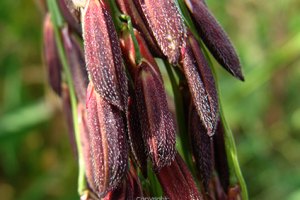
on the auspicious occasion of His Majesty's 80th birthday on 5 December 2007, and in honor of his having devoted his strength to promoting and supporting the development of rice and Thai rice production for the great benefit of his subjects and Thailand. The medal is made of 96.5% pure gold, weighs 29 baht, and has a diameter of 9.9 centimeters. The front center of the medal bears the royal portrait of King Bhumibol Adulyadej; the back center bears the text “80th Birthday”, with ears of rice below and the text “Golden Rice”. Inside the medal are the grains of 9 rice varieties, consisting of varieties used in the Royal Ploughing Ceremony: Pathum Thani 1, Suphan Buri 1, Khao Dawk Mali 105, RD6, Phatthalung and Phitsanulok 1 non-glutinous rice; a native variety, Sangyod; and newly developed varieties, flash-flood-tolerant Khao Dawk Mali 105 and Riceberry. They also respectfully reported on the patent on the gene that controls aroma in rice, which the Ministry of Science and Technology, through the National Center for Genetic Engineering and Biotechnology, the National Science and Technology Development Agency and Kasetsart University, had discovered. This discovery is of great benefit to Thailand in protecting the commercial use of the aroma gene, building understanding of how aroma compound production in rice is controlled, and further rice breeding. The United States Patent and Trademark Office issued the patent on 15 January 2008. Patent applications have also been filed in the Commonwealth of Australia, the People's Republic of China, the Republic of the Philippines, Thailand, Japan, the Socialist Republic of Vietnam, the Republic of India, the French Republic and the European Union countries.
On this occasion, His Majesty the King gave a royal address as guidance for the work of the delegation who had been granted an audience:
| "Thank you for patenting this, which is a guarantee that Thai rice is truly Thai. Before, I was worried that we had eaten Thai rice for so long and it might turn into foreigners' rice, because the patent would belong to foreigners. But this patent will be a guarantee that we eat Thai rice and will keep eating Thai rice. So having this patent is important, and I hope everyone will preserve their Thai identity by eating Thai rice, not foreign rice. Thank you to everyone who has been involved in this. On behalf of all Thais who are proud to eat Thai rice, thank you to everyone who has worked hard on this. Please keep working togetherso that we can eat Thai food, eat Thai rice, and not have to eat foreign rice. Eating Thai rice makes Thai people proud of being Thai, and able to go on being Thai." |
After His Majesty the King finished his royal address, he spoke closely with the delegation and once again thanked the agencies concerned for working together. He also graciously suggested that attention be given to patenting purebred Thai dogs, citing as an example the family of Tongdaeng, the royal dog born in Thailand.