
This device has no English text-to-speech voice, so the article may not be read aloud.
Rice Variety · Riceberry
Riceberry is a newly registered (2002) rice variety from Thailand originated from a cross-breed between Jao Hom Nin (JHN), the local non-glutinous purple rice and Khoa Dawk Mali 105, the Thai Hom Mali Rice, by Rice Science Center, Kasetsart University, Thailand. From 4 years of strenuous selection for nutritional properties, anthocyanin stability, physical and cooking properties. The outcome is the deep purple whole grain rice with softness and palatable after taste.
Riceberry has been the most popular brown rice known for health promoting properties. Attracting people to consume more brown rice is the most significant steps in solving food-related chronic diseases like diabetes, heart disease, high blood chloresterol, obesity and cancers.

Breeding story
Origins and selection
Riceberry is a new non-glutinous rice variety selected and developed by crossing Hom Nin non-glutinous rice from Kasetsart University (male parent) with Khao Dawk Mali 105 from the Rice Research Institute (female parent). Crossing began in 2002 (B.E. 2545) at the Rice Science Center, Kasetsart University, Kamphaeng Saen Campus.
The F1 hybrid was allowed to self-pollinate, and F2 seed was collected and grown, numbering more than 10,000 plants. F2 plants were selected by observing plant type with good yield, good seed set and slender grain shape. Grain quality was then evaluated by hulling the grain and observing uniformity, clarity-versus-opacity of the grain, and breakage from milling. F3 families were then selected for growing, and families whose plants have high yield, good seed set, large and slender grains, no neck blast and clean husks were selected, selecting lines with brown rice grain
Where it grows
Production and Cultivation
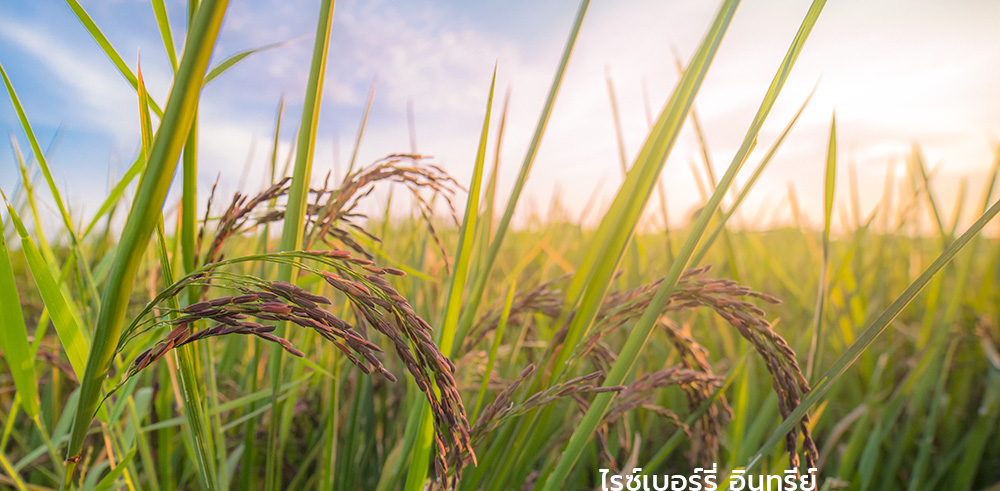
The areas of Riceberry rice production are in the Northern and North-East of Thailand. During the months of August to December (wet season) is suitable for Riceberry planting. Table Agronomic characteristics, grain quality and cooking quality of Riceberry.
Characteristics
Variety Characteristics
- Plant height
- 105 - 110 cm
- Day of maturity
- 130 Days
- Yield
- 300 - 500 kg/rai
- Brown rice
- 76 %
- Head rice
- 50 %
- Amylose
- 15.6 %
- Gel Temperature
- < 70 °C
- Photoperiod sensitivity
- Photoperiod insensitive
Grain Length
- Paddy rice
- 11 mm
- Brown rice
- 7.5 mm
- Polished rice
- 7.0 mm
Nutrition Properties
Nutrition Properties of Brown Rice
Nutritional value: Riceberry bran contains anthocyanin at a concentration of 15.7 mg/100 g, and Riceberry bran has an ORAC value of up to 400 Trolox eq./g. The latest research found that Riceberry bran contains the anti-cancer active compound lupeol and other compounds still being extracted, the first report of lupeol being found in rice. As for cold-pressed rice bran oil, compared with cold-pressed sesame oil, it contains beta-carotene at 23 µg/g and lutein at 14–15 µg/g (absent in sesame oil), together with gamma-oryzanol at 135 µg/g, with an ORAC value of 215 µmol Trolox/g.
Tests of the properties of Riceberry bran extracts against 3 types of cancer cells, namely colon cancer cells (Caco-2), breast cancer cells (MCF-7) and leukemia cells (HL-60), found that both the extract that was not de-oiled (DCM fraction) and the partly de-oiled extract (MeOH fraction) significantly inhibited all 3 types of cancer cells. These data show that Riceberry bran is a source of anti-cancer active compounds.
Riceberry · Nutrition
Riceberry is enriched with both water soluble, mainly anthocyanin and lipid soluble antioxidants, such as carotenoid, gamma oryzanol, and vitamin E. All nutritive properties of Riceberry are contained in its rice bran... In clinical studies at Ramathibodi Hospital, Riceberry whole-grain rice has a "medium" glycemic index (GI=62).
Nutrition Facts
Nutrition Facts
- Iron
- 13-18 mg/kg
- Zinc
- 31.9 mg/kg
- Omega 3
- 25.51 mg/100g
- Vitamin E
- 678 ug/100g
- Folate
- 48.1 ug/100g
- Beta Carotene
- 63 ug/100g
- Polyphenol
- 113.5 mg/100g
- Tannin
- 89.33 mg/100g
- Gamma Oryzanol
- 462 ug/g
Antioxidant
- Water-soluble
- 47.5 mg ascorbic acid equivalent/100g
- Oil-soluble
- 33.4 mg trolox equivalent/100 g
Patent
Plant variety protection
Riceberry has been registered as a new plant variety (Riceberry rice was certified Plant varieties protection (PVP) by the Plant varieties protection division, Thailand.)
Trademark
Registered trademark
Riceberry has been registered as a trademark at the Department of Intellectual Property, Ministry of Commerce, and abroad.
Cultivation
How to grow Riceberry
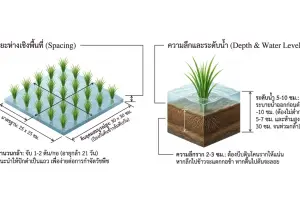
Study the information on organic growing and proper care.
References
References
- Riceberry - Rice Gene Discovery & Rice Science Center (RGD&RSC). Kasetsart University.
- Apichart Vanavichit, Pornrat Sinchaipanich, Sukanya Wongpornchai, Ratchanee Kongkachuichai, et al. (2008). Research report: Project on integrating biotechnology in breeding rice for added value and high quality. NRCT.
- Ratchanee Kongkachuichai et al. (2010). Preliminary study of nutritional value and cell-level assessment of iron bioavailability from rice. NRCT.
- Leardkamolkarn V, et al. 2011. "Chemopreventive properties of the bran extracted from a newly-developed Thai rice: The Riceberry". Food Chemistry. 125 (3): 978-985.
- Sriwattana Songchitsomboon et al. (2005). Glycemic index in high-nutrition rice. NRCT.
- Prangthip, P., et al. 2013. "Amelioration of hyperglycemia... by riceberry supplement". Journal of Functional Foods. 5 (1):195-203.
- Kongkachuichai, R., et al. 2013. "Effect of Riceberry oil supplementation...". International Food Research Journal. 20 (2): 873-882.
- Wassanan Pannangroung, et al. 2011. "Purple Riceberry is neuroprotective and enhances cognition...". Medical Food 14:688-94.