
This device has no English text-to-speech voice, so the article may not be read aloud.
The non-glutinous rice “variety Pinkaset+6” was obtained by pseudo-backcrossing, using the variety Pinkaset4 as the recipient line (female parent) and 2 donor lines (male parents): the heat-tolerant mutant (Mu9962) and the iron-toxicity-tolerant mutant (MuFRO). Crossing was carried out at the Rice Science Center, Kasetsart University, Kamphaeng Saen Campus, Nakhon Pathom, under the research project “Whole-Genome Mutagenesis Technology to Enhance Breeding of Environmentally Friendly Rice”, supported by the National Science and Technology Development Agency (NSTDA) in 2012 (B.E. 2555), giving F1 hybrids from 2 crosses, Pinkaset+4/Mu9962 and Pinkaset+4/MuFRO, in 2015 (B.E. 2558). The F1 plants were then grown and the true F1 plants (successful crosses) selected using at least 1 molecular marker for a gene controlling the target trait. The F1 plants were backcrossed to Pinkaset+4, the recurrent parent, giving BC1F1 from 2 crosses. BC1F1 plants from each cross that received the target genes were selected, namely genes for blast resistance, bacterial leaf blight, brown planthopper, flash flood tolerance, amylose, cooked starch temperature and aroma in both crosses, along with genes related to heat tolerance (for the cross Pinkaset+4/Mu9962) or iron toxicity tolerance (for the cross Pinkaset+4/MuFRO), using MAS in 2016 (B.E. 2559). Pseudo-backcrossing was then carried out by crossing selected BC1F1 plants from the 2 crosses that already had all target genes, giving the pseudo BC2F1 population, and pseudo BC2F1 plants that received the target genes were selected using MAS in 2016. The pseudo BC2F1 was then allowed to self-pollinate to give pseudo BC2F2, which was grown and selected for plants that received the target genes using MAS, and allowed to self-pollinate to give pseudo BC2F3 in 2017 (B.E. 2560). In 2018 (B.E. 2561), pseudo BC2F3 was allowed to self-pollinate to give pseudo BC2F4, which was then grown to evaluate the efficiency of MAS selection by testing resistance to blast, bacterial leaf blight and brown planthopper and tolerance of flash floods. Yield comparisons were then grown at Kasetsart University in 2018. In 2019 (B.E. 2562), the lines were grown for testing in farmers' fields in Nakhon Ratchasima and Chiang Mai Provinces. Then in 2020–2021 (B.E. 2563–2564), the Rice Science Center's rice lines with good yield potential, funded by the Program Management Unit for Human Resources & Institutional Development, Research and Innovation (PMU-B), were again grown for yield testing within Kasetsart University, Kamphaeng Saen Campus.
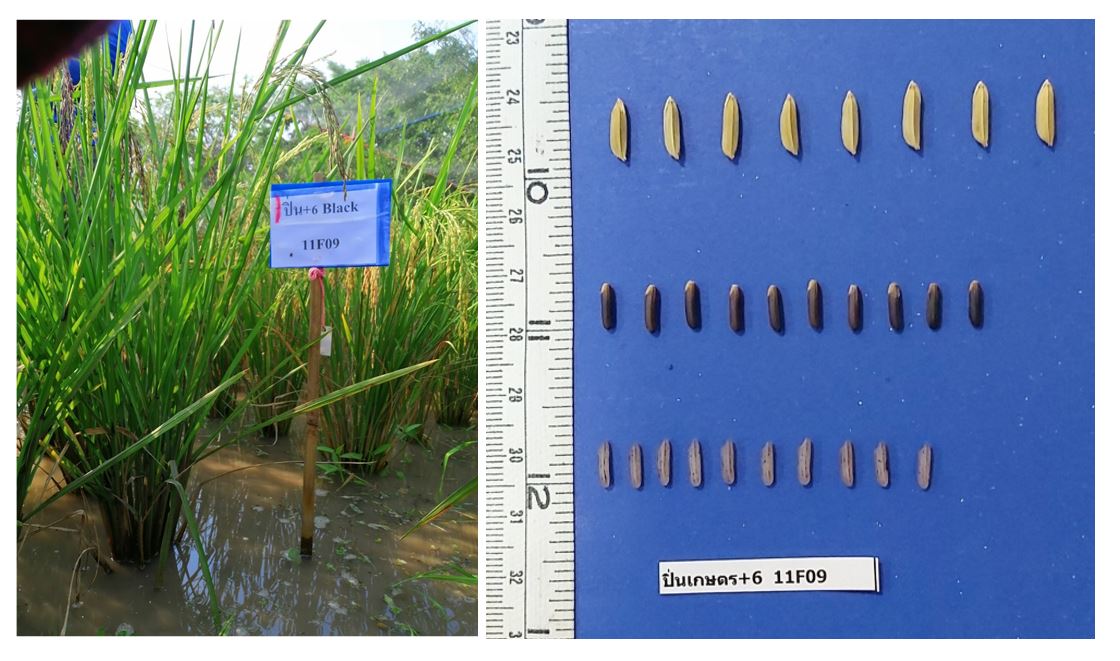
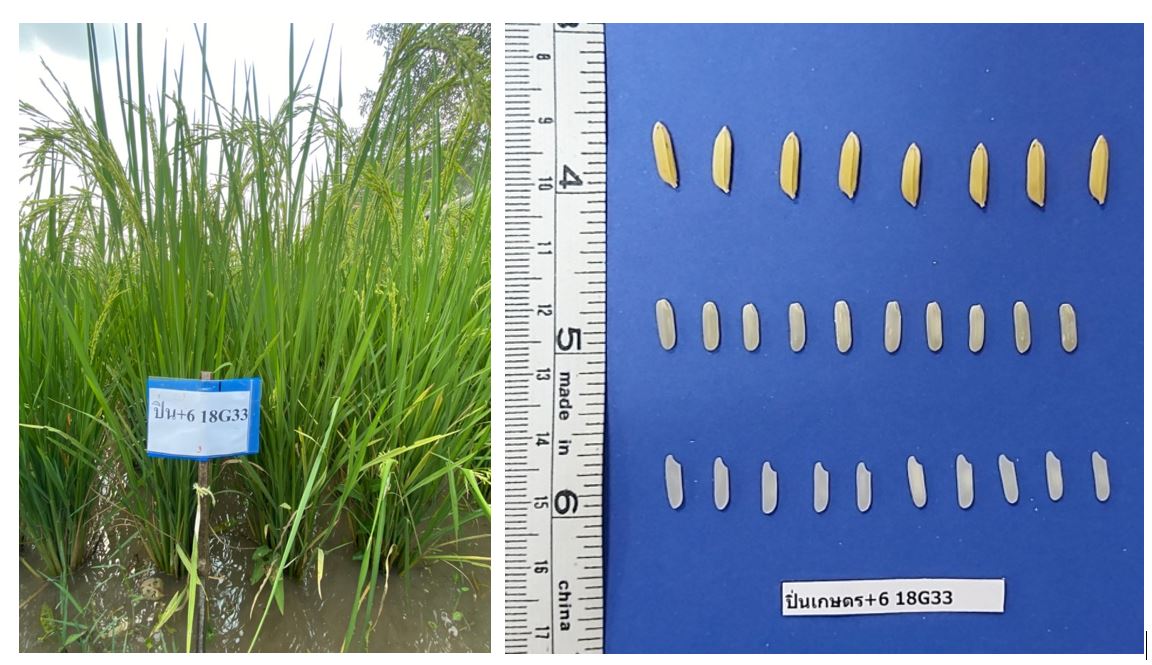
The selected pure lines number 9 Pinkaset+6 lines, which are photoperiod insensitive, fragrant and high-yielding, with both white brown rice and purple brown rice lines, resistant to blast, bacterial leaf blight and brown planthopper, and tolerant of flash floods, heat and iron toxicity.