This device has no English text-to-speech voice, so the article may not be read aloud.
[Register to grow Hom Siam rice]
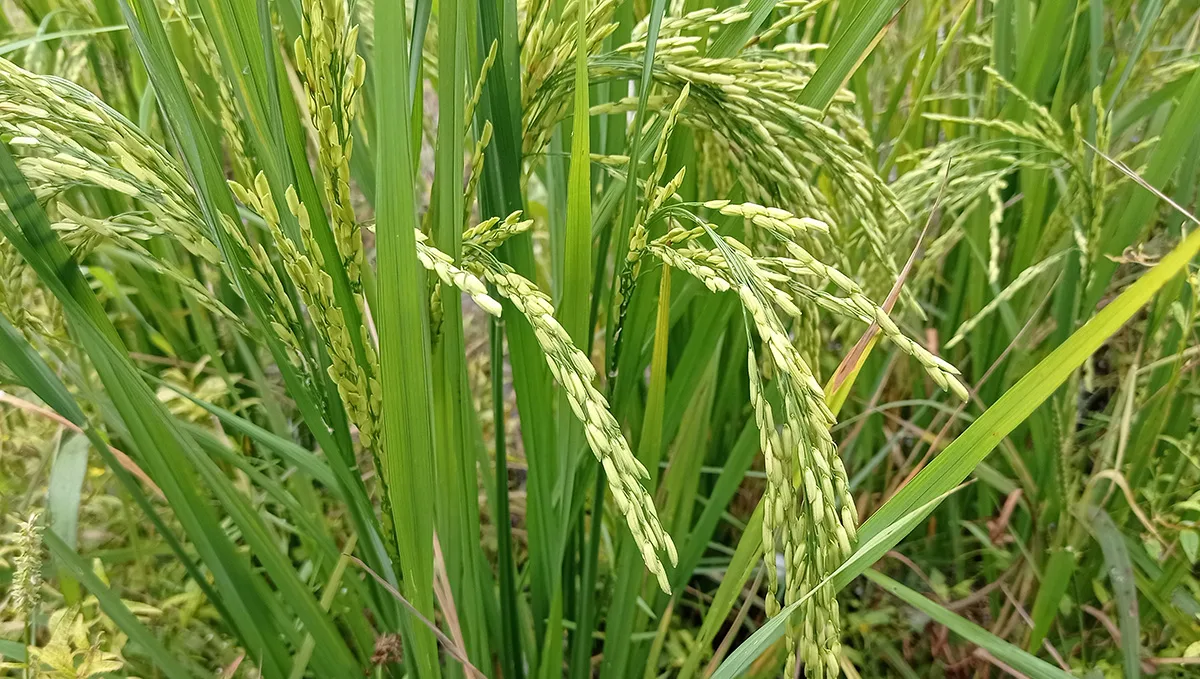
The non-glutinous rice variety “Hom Siam” is a soft fragrant non-glutinous rice, photoperiod sensitive, of medium height, with high yield and cooking quality as good as Khao Dawk Mali 105, resistant to blast and drought through root anatomy that differs from Khao Dawk Mali 105. It was obtained by backcross breeding together with DNA marker-assisted selection, between the female parent line “RGD03068-2-9-1-B (RGD03068)”, which has drought tolerance, and the male parent line “Kaew Kaset”, which resists blast, has an upright hill and short stature, in 2010 (B.E. 2553) at the Rice Gene Discovery Laboratory, National Center for Genetic Engineering and Biotechnology, Kasetsart University, Kamphaeng Saen Campus, Nakhon Pathom, supported by research funding from NSTDA.

Special features Soft fragrant rice, photoperiod sensitive, with fragrant grains, soft and delicious like Khao Dawk Mali 105, with a strong stem that does not lodge easily. Medium height, high yield, resistant to blast and drought tolerant
| Variety characteristics | Khao Dawk Mali 105 | Hom Siam non-glutinous rice |
| Photoperiod sensitivity | Photoperiod sensitive | Photoperiod sensitive |
| Height | 150 centimeters | 120 centimeters |
| Hill shape | Spreading hill, about 45 degrees | Upright hill |
| Stem strength | Weak, lodges easily | Strong, does not lodge |
| Number of tillers | About 11 tillers | About 15 tillers |
| Panicle length | 28 centimeters | 28 centimeters |
| Panicles per hill | 10 panicles | 13 panicles |
| Grains per panicle | 140 grains | 220 grains |
| Grain characteristics | Straw-colored husk with short hairs | Straw-colored husk with short hairs |
| Paddy grain length | 10.60 millimeters | 10.56 millimeters |
| Brown rice length | 7.50 millimeters | 7.35 millimeters |
| Milled rice length | 7.20 millimeters | 7.21 millimeters |
| Amylose content | 16.7 percent | 17.5 percent |
| Alkali spreading value | 6 (low) | 7 (low) |
| Gel consistency | 66.5 millimeters | 71.3 millimeters |
| Softness | Soft | Soft |
| Aroma | 1.44 ppm | 1.19 ppm |
| Average yield | 250 kilograms per rai | 530 kilograms per rai |

| Grain characteristics | Khao Dawk Mali 105 | Hom Siam |
| Paddy grain length | 10.60 millimeters | 10.56 millimeters |
| Brown rice length | 7.50 millimeters | 7.35 millimeters |
| Milled rice length | 7.20 millimeters | 7.21 millimeters |
| Amylose content | 16.7 percent | 17.5 percent |
| Alkali spreading value | 6 (low) | 7 (low) |
| Gel consistency | 66.5 millimeters | 71.3 millimeters |
Yield Hom Siam yields more than 50% higher than Khao Dawk Mali 105 because of increased yield components: the number of tillers per hill is 27% higher than Khao Dawk Mali 105, and the number of grains per panicle is 36% higher than non-glutinous Khao Dawk Mali 105. Hom Siam is also about 20% shorter, with a strong stem that does not lodge, whereas when Khao Dawk Mali 105 lodges, yield is damaged by 50%.
(Yield of Hom Siam increased more than 50% compared with KDML105 due to the 36% increase in number of seed per panicle and 27% increase in tiller number. Hom Siam is also resistant to lodging due to strong stem and decrease in height by 20% compared with KDML105.)
Root system Under normal flooded conditions, Hom Siam has about 50% more roots than Khao Dawk Mali 105, and under drought Hom Siam has about 20% more roots than Khao Dawk Mali 105, and also has a deep root system that helps absorb water and nutrients to sustain growth and yield.
(Under well-watered condition, Hom Siam has total root number 50% more than KDML105. Under drought stress, Hom Siam has a total root number of 20% than KDML105 and maintain more deep roots and that help in maintaining water status in the rice plant and contributes to the increase of biomass under stress)

| Normal flooded conditions | Drought conditions |
Precautions Susceptible to bacterial leaf blight and brown planthopper
Disease resistance Hom Siam has broad resistance to blast
Register To grow Hom Siam on farmers' land in the 2022 growing season [Register: click]
{os-gal-26}