This device has no English text-to-speech voice, so the article may not be read aloud.

The glutinous rice “Hom Naka” resulted from crossing the line RGD10033-77-MS22 as the female parent and the line RGD11169-MS8-5 as the male parent at the Rice Gene Discovery Laboratory, National Center for Genetic Engineering and Biotechnology, Kasetsart University, Kamphaeng Saen Campus, Nakhon Pathom, in 2013 (B.E. 2556), giving F1 hybrids that were allowed to self-pollinate to give F2. Plants were then selected for photoperiod insensitivity, plant type with good yield, good seed set, slender grain shape and glutinous type, by the pedigree method. Continued selectionin the same way in the F3 generation. Selection was then made for aroma, flash flood tolerance, blast resistance and bacterial leaf blight resistance, using molecular markers to help selection, in the F4 and F5 populations, until plants were obtained that are glutinous, photoperiod insensitive, fragrant, flash-flood-tolerant, and resistant to blast and bacterial leaf blight. They were then allowed to self-pollinate and advanced to the F6 generation. The F6 population was then evaluated for flash flood tolerance, blast resistance, yield and yield components, and for physical and chemical cooking quality at the Rice Gene Discovery Laboratory, National Center for Genetic Engineering and Biotechnology, Kasetsart University, Kamphaeng Saen Campus, Nakhon Pathom.
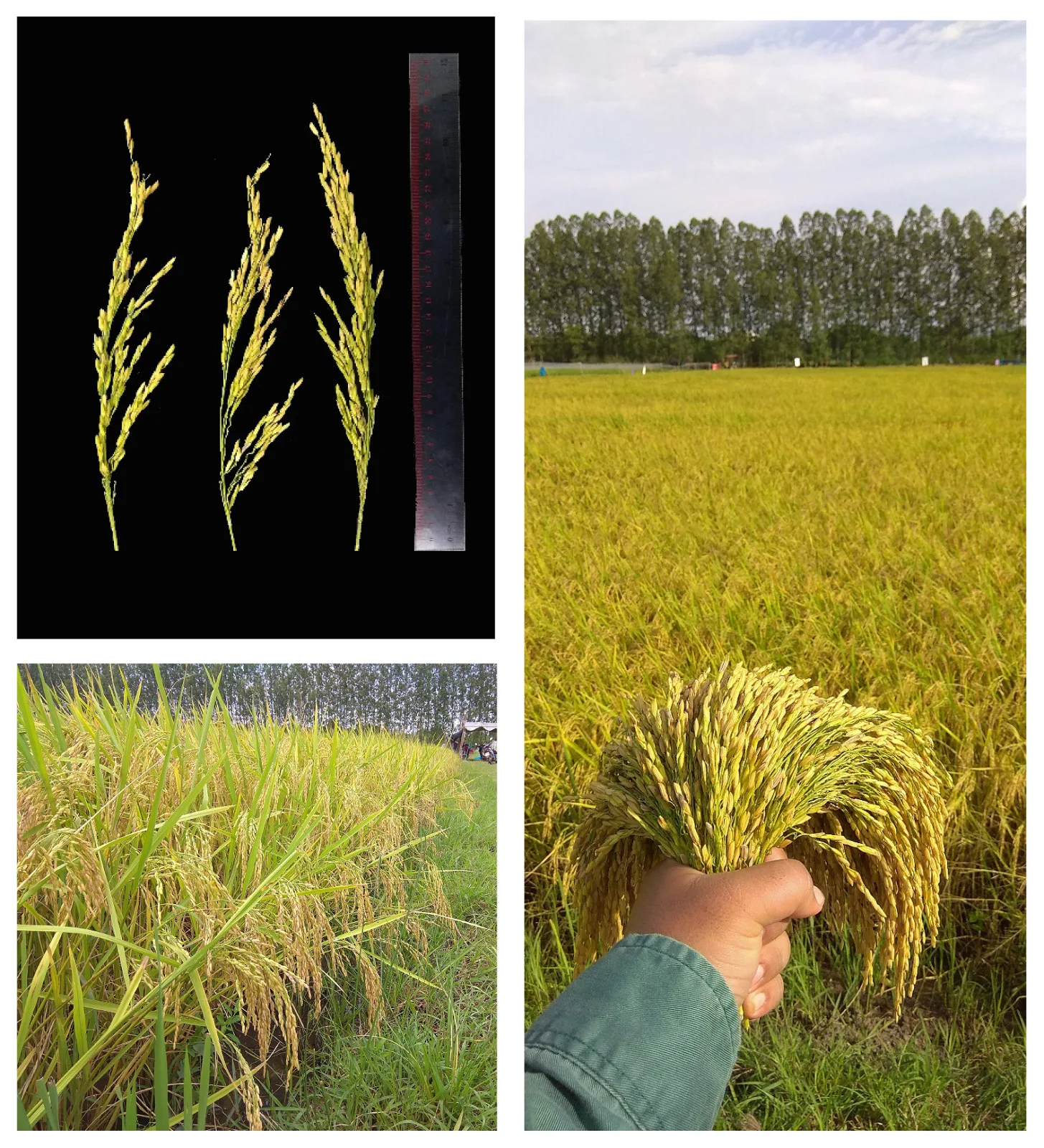
Trial planting in farmers' fields in Lampang, Phayao and Chiang Rai Provinces, together with Rajamangala University of Technology Lanna, in 2019 (B.E. 2562), led to the selection of the glutinous rice “variety Hom Naka” which has white glutinous grains, aroma, soft and sticky texture when cooked, flash flood tolerance, resistance to blast and bacterial leaf blight, a strong stem that does not lodge easily, medium plant height, and a high average yield of 930 kilograms per rai (susceptible to brown planthopper and to brown spot disease).
Variety characteristics
| Species | Thai name: rice. Scientific name: Oryza sativa L. Family Poaceae |
| Type | Annual herb, glutinous rice, photoperiod insensitive |
| Plant | Upright hill, strong stem that does not lodge easily, plant height measured to the panicle tip 126 centimeters, light yellow internodes, stem diameter 5 millimeters |
| Leaf | Simple leaf, strap-shaped, width 1.8 centimeters, length 43.0 centimeters, pointed tip, smooth margin, hairy leaf blade, green leaf sheath, white ligule with a two-forked tip 10 millimeters long, light green auricles, light green collar, green leaves, flag leaf angle 45 degrees to the vertical, width 1.2 centimeters, length 27.4 centimeters, slow leaf senescence |
| Flower/Inflorescence | Branched panicle, 12 panicles per hill, medium branching, short neck, straw-colored sterile lemma, white stigma tips |
| Fruit/Grain | At harvest, panicle length 23 cm, straw-colored husk with short hairs, no awn, straw-colored tip. Paddy grain width 2.39 mm, length 10.19 mm, thickness 1.95 mm. Brown rice slender and long, white, width 2.17 mm, length 6.97 mm, thickness 1.80 mm. Milled rice opaque white, width 1.89 mm, length 6.88 mm, thickness 1.66 mm. 1,000-grain paddy weight 29.5 grams, 163 grains per panicle, seed set 80.47 percent. |
| Cooking quality | Amylose content 6.27 percent, alkali spreading value 6.0 and gel consistency 131 mm. |
| Outstanding traits | Resistant to blast, resistant to bacterial leaf blight and tolerant of flash floods |