This device has no English text-to-speech voice, so the article may not be read aloud.
Importance of the research:
The non-glutinous rice “Hom Jinda” was obtained by conventional crossbreeding between the variety Pathum Thani 1 as the female parent and the line RGD07097-1-MAS-8-9-0-0 as the male parent at the Rice Gene Discovery Laboratory, National Center for Genetic Engineering and Biotechnology, Kasetsart University, Kamphaeng Saen Campus, Nakhon Pathom, in 2013 (B.E. 2556), producing F1 hybrids that were allowed to self-pollinate to give the F2 generation. Plants carrying the aroma gene and the bacterial leaf blight resistance gene were then selected using molecular markers. They were allowed to self-pollinate to give the F3 generation, which was grown to select plants that flower early, with good plant type, large panicles, good seed set and slender grain shape, by the pedigree method, and bacterial leaf blight resistance was assessed in the F3 and F5 generations. Seed was sent to assess yield and yield components in the experimental plots of the Ruamjai Pattana Foundation in 2017 and 2018 (B.E. 2560 and 2561), selecting a soft fragrant non-glutinous rice resistant to bacterial leaf blight, with a strong stem that does not lodge easily, medium plant height, and a high average yield of 838 kilograms per rai.

Botanical characteristics
- Type: fragrant non-glutinous rice, photoperiod insensitive
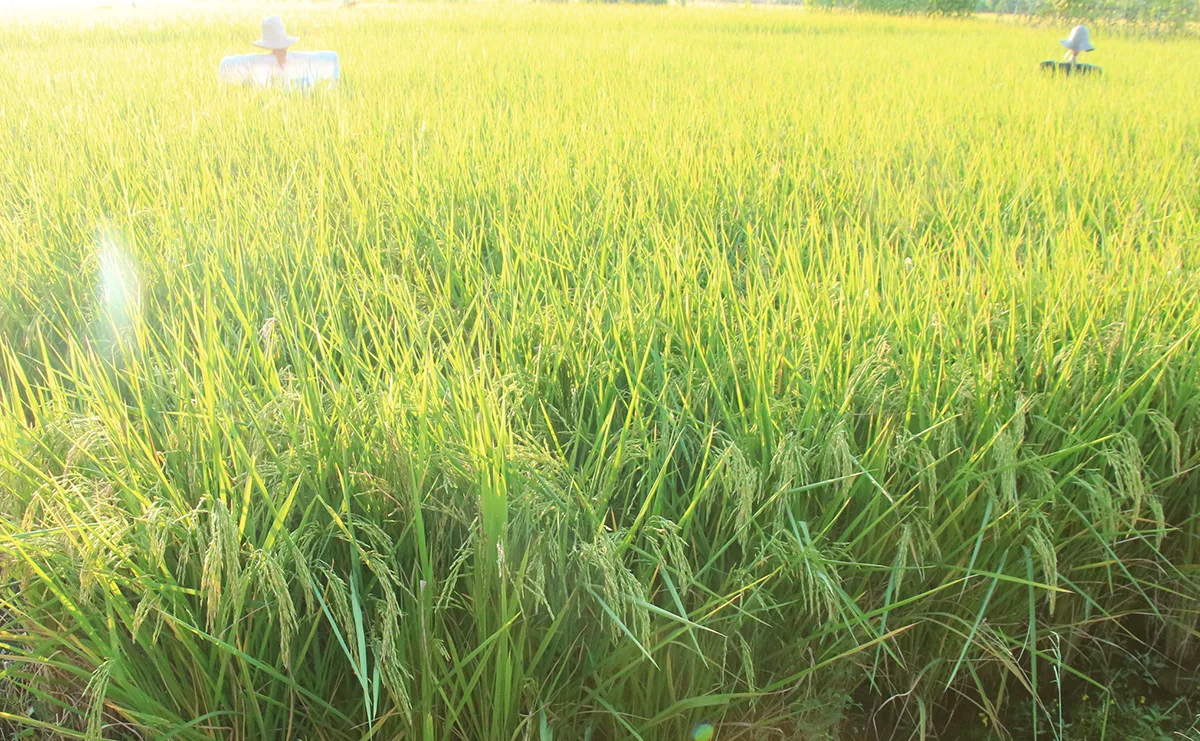
- Plant: upright hill, strong stem that does not lodge easily, plant height measured to the panicle tip 118 cm, green internodes, stem diameter 5 mm.
- Leaf: simple leaf, strap-shaped, width 1.7 cm, length 53.5 cm, pointed tip, smooth margin, hairy leaf blade, green leaf sheath, white ligule with a two-forked tip 10.43 mm long, light green auricles, light green collar, dark green leaves, flag leaf angle 45 degrees to the vertical panicle stalk, width 1.6 cm, length 41 cm, slow leaf senescence.
- Flower/inflorescence: branched panicle, 24 panicles per hill, medium branching, neck well exserted, soft panicle stalk, white stigma tips, sterile lemma (the 2 lower reduced florets with only the lower glume remaining) straw colored, white female stigma.
- Harvest age 110–120 days, panicle length 22 cm, straw-colored husk with short hairs and a short awn. Paddy grain width 2.36 mm, length 10.85 mm, thickness 1.72 mm. Brown rice grain width 1.98 mm, length 7.07 mm, thickness 1.58 mm. 1,000-grain paddy weight 27.2 grams, 171 grains per panicle, medium seed set (75–90 percent), grain shattering 1–5 percent, threshing shattering of more than 50 percent.
Other characteristics
- Alkali spreading value 6
- Gel consistency 131 mm.
- Aroma value 4.89 ppm
- Amylose content 16.77 percent
Special outstanding traits:
- Cooked grains soft and fragrant
- Resistant to bacterial leaf blight isolate TX085 collected from Surin Province and isolate TX0155 collected from Nakhon Pathom Province
Contact information:
- National Center for Genetic Engineering and Biotechnology (BIOTEC)
- National Science and Technology Development Agency (NSTDA) Email icp-prs@biotec.or.th Tel. 0 2564 6700 ext. 3329-3331