
This device has no English text-to-speech voice, so the article may not be read aloud.
|
Thunya Sirin glutinous rice: blast resistant Her Royal Highness Princess Maha Chakri Sirindhorn bestowed the name “Thunya Sirin” on a rice developed by the Rice Gene Discovery Unit, National Center for Genetic Engineering and Biotechnology (BIOTEC), National Science and Technology Development Agency (NSTDA), Kasetsart University, together with the Rice Research and Development Bureau of the Rice Department and Rajamangala University of Technology Lanna. The blast-resistant glutinous rice line was developed using molecular markers in selection together with standard breeding methods, giving a glutinous rice whose quality is close to RD6 but with blast resistance. Development began in 2002 and took about 4 years.
BIOTEC and Rajamangala University of Technology Lanna carried out the project "Technology transfer and monitoring of new seed production so farmers have seed to use themselves in their communities", with cooperation from provincial administrative organizations and the public and private sectors in the northeast, to develop the blast-resistant, short-statured RD6 glutinous rice "Thunya Sirin", using molecular markers related to blast resistance genes and cooking quality in selection together with standard breeding methods, until a glutinous rice well adapted to the paddy areas was obtained.
Dr. Theerayut Toojinda, Senior Researcher at the National Center for Genetic Engineering and Biotechnology, or BIOTEC, said that the development of the variety "Thunya Sirin", an RD6 glutinous rice that resists blast, an important disease in rainfed paddies of the northeast, involved trial planting to transfer seed to farmers in communities, in participation with farmers in the north and northeast, using blast- and bacterial-leaf-blight-resistant, short Thunya Sirin numbers 13, 8 and 5, which came from breeding by crossing lines using technology, and distributing them to areas for trial planting.
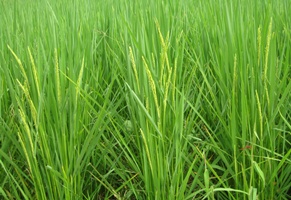
"Farmers can choose how to grow rice to make a profit each year, with researchers providing information and following up on the growing results. Our Thunya Sirin variety has the advantages of good tillering, a strong stem that does not lodge easily, an average height of 130 centimeters, easy harvesting by machine, less lodging, high yield and good cooking quality."
Dr. Theerayut added that for setting up demonstration farm plots for trial planting of rice, data are recorded and collected and rice lines assessed to select varieties suited to the area, which is a very important factor in strengthening farmers' potential, using science and technology to help build knowledge in the community.
Dr. Kanyanat Sirithanya, the project leader, added that BIOTEC began the project by taking 2 new glutinous lines to trial planting in the northeast, namely Thunya Sirin, from 2012 (B.E. 2555), with farmers satisfied. But in some areas with outbreaks of blast and bacterial leaf blight, open fields and strong winds damaged yield, and because of those problems, in 2013 (B.E. 2556) BIOTEC developed "RD6 Thunya Sirin, short, resistant to
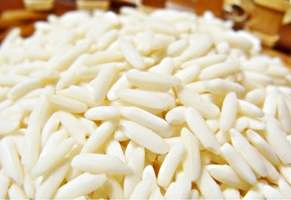
blast and bacterial leaf blight", which was trial-planted in several areas of the northeast, such as Tao Ngoi, Charoen Sin and Kham Ta Kla Districts of Sakon Nakhon Province, with the rest spread across areas such as Rattanawapi and Tha Bo Districts of Nong Khai Province and Mueang District of Bueng Kan Province. "It is a photoperiod-sensitive main-season rice whose outstanding traits are resistance to blast and bacterial leaf blight, a strong stem with an average height of 130 centimeters, making it easy to harvest, slender long grains, and an average yield of 700–800 kilograms per rai."
Anongluk Yaipan, a farmer with a model rice plot, admitted that taking part in the project growing RD6 Thunya Sirin, resistant to blast and bacterial leaf blight, meant farming organically combined with rice-growing technology, giving high yield and letting her produce rice seed to use in each year's farming season. Each year's yield is sent to the community rice center to sell to members so they can continue farming.
Breeding the glutinous rice "Thunya Sirin" is a way of producing rice seed for communities and also increases the role of farmers, especially in the northeast, for sustainable development.
|