This device has no English text-to-speech voice, so the article may not be read aloud.

"The Problem" 66 percent of the world's population suffers from anemia caused by iron deficiency. In Thailand, about 13 million people are found to have iron depletion or deficiency. People with iron deficiency develop more slowly than normal in many aspects of the body, with lower intellectual development, learning, work efficiency and immunity. Existing strategies to prevent iron deficiency usually supplement iron tablets or add iron to the food consumed, but they still face problems of acceptance and of reaching target populations thoroughly, and the cost is rather high. Raising the iron content of staple food crops seems a potentially precise and effective way to solve the problem. In Thailand, rice is the staple food that everyone must eat, so breeding rice with higher iron content should be an important measure for solving the problem.
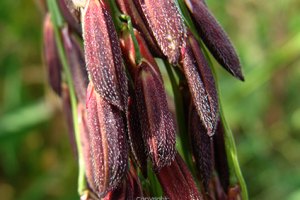
Improving iron density in rice grains The iron density of rice grains is low compared with other cereals. On average Thai people eat 200–250 grams of rice per day. If the body's average iron requirement is 15 mg per day (RDA), rice grains would need an iron density of 5 mg per 100 grams for consumers to get one-third of the RDA from rice. Currently, commonly consumed rice varieties have iron in brown rice below 1.3 mg/100 g. Breeding rice for high iron is therefore carried out by searching native rice for high-iron types to serve as donors of the high-iron trait, which are mostly found in black-grained rice. However, using rice from the natural genetic base has limits, because dark rice often contains large amounts of iron-absorption inhibitors such as polyphenols, tannins and phytate, while white rice contains lower amounts of inhibitors. Efforts have therefore been made to cross white rice with purple-black rice to transfer the high-iron trait to white rice varieties. The first step's success was finding rice with 1.6–2.1 mg/100 g iron in brown rice. The pure line obtained was named Sinlek; it is white, fragrant and has fairly low amylose. Later, white non-glutinous and glutinous rice with high iron of 2.2–2.8 mg/100 g were found from crosses between the upland rice Hom Phama and Kam Doi Chang. The rice with the highest iron, at 4.0 mg/100 g, came from a cross between wild rice Nivara and Jao Hom Nin. The next step in breeding is to improve the bioavailability of the iron in the grain.
Bioavailability of iron It is difficult to improve iron in rice and cereal grains to the greatest bioavailability, because bioavailability involves many factors, such as the form in which iron is stored and the proportion of enhancers and inhibitors of iron absorption. Cereal grains naturally contain large amounts of substances that inhibit iron absorption, such as polyphenols, tannins and phytate. Reducing these substances is the main goal of crossing to create rice varieties with iron in a highly bioavailable form. As for factors that promote absorption, they are not yet clearly understood; it is only known that vitamin C, amino acids such as cysteine, and short-chain oligosaccharides such as inulin probably help make iron absorption from polished rice more efficient.
 The first simulated iron bioavailability testing laboratory in Thailand
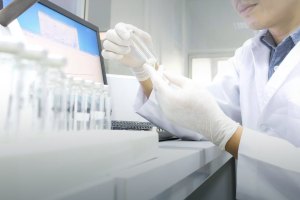
A method has been developed to test iron bioavailability using Caco-2 cells, which mimic digestion and absorption of nutrients in the real human body. This technique helps screen high-iron, highly bioavailable rice lines initially before selecting outstanding lines for human testing. Cell-level iron bioavailability tests on more than 100 bred rice lines found that Sinlek, a line from the cross between Pin Kaset and IR71501 with low amylose, and white glutinous rice from the cross between Hom Phama and Kam Doi Chang had high to very high iron bioavailability, about 15–22 nanograms of ferritin per milligram of cell protein. These lines are the main ones to be used for human testing next.
The first simulated iron bioavailability testing laboratory in Thailand
A method has been developed to test iron bioavailability using Caco-2 cells, which mimic digestion and absorption of nutrients in the real human body. This technique helps screen high-iron, highly bioavailable rice lines initially before selecting outstanding lines for human testing. Cell-level iron bioavailability tests on more than 100 bred rice lines found that Sinlek, a line from the cross between Pin Kaset and IR71501 with low amylose, and white glutinous rice from the cross between Hom Phama and Kam Doi Chang had high to very high iron bioavailability, about 15–22 nanograms of ferritin per milligram of cell protein. These lines are the main ones to be used for human testing next.
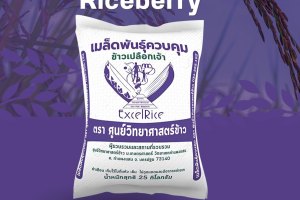
Testing iron absorption in humans, Phase 1 study For the first time, iron absorption was tested in humans using 63 volunteers, with 2 high-iron rice lines, Sinlek and Riceberry, compared with polished Pin Kaset rice, using the extrinsic-label radioiron technique. The experiment found that the percentage of iron the human body could absorb was highest in polished Sinlek rice, at 9.82. It was also found that iron absorption from both polished rice lines was about 3 times higher than from brown rice, even though polished rice contains less iron than brown rice.
Phase 2 study This studies the effect of high-iron rice and its products on the nutritional status of school-age children with iron deficiency, selecting students with iron deficiency and anemia to eat high-iron Sinlek rice and its products for 8 months, compared with a group eating rice sold in general markets, by assessing changes in the body's stored iron levels as an indicator of the efficiency of Sinlek rice.
 Steps toward promotion
Growing high-iron rice in target areas
Following the success in developing high-iron rice lines, uniformity tests of the line are now being grown in different areas, an application for new plant variety protection is being filed at the Plant Variety Protection Division, Department of Agriculture, Ministry of Agriculture and Cooperatives, and preparations are being made to multiply enough seed to promote planting among target farmer groups, especially in areas with populations at risk of anemia from iron deficiency.
Steps toward promotion
Growing high-iron rice in target areas
Following the success in developing high-iron rice lines, uniformity tests of the line are now being grown in different areas, an application for new plant variety protection is being filed at the Plant Variety Protection Division, Department of Agriculture, Ministry of Agriculture and Cooperatives, and preparations are being made to multiply enough seed to promote planting among target farmer groups, especially in areas with populations at risk of anemia from iron deficiency.
In cooperation with the Research Office, Faculty of Medicine Ramathibodi Hospital, Mahidol University, Phaya Thai, Bangkok, Department of Radiology, Faculty of Medicine Siriraj Hospital, Bangkok Noi, Bangkok Institute of Nutrition, Mahidol University, Salaya, Phutthamonthon, Nakhon Pathom Supported by a research grant for socio-economic development through science and technology from the National Research Council of Thailand