
This device has no English text-to-speech voice, so the article may not be read aloud.
Mutagenesis technology
Mutation occurs naturally and slowly, giving rise to the diversity of rice varieties we have today. Encroachment on natural areas has caused the loss of natural genetic resources, so the chance of finding new genetic sources is now very small. Mutagenesis technology uses radiation or mutagens to stimulate the genome to mutate faster, creating pronounced variation that is hard to find in nature today.
This leading researcher project sees the bottleneck in accessing natural sources of variation and in bringing mutated genes back to benefit us once again.
Environmentally friendly rice is rice that adapts well to the environment and to the diseases and insects that limit growth, so it can maintain yield without much loss and without needing pesticides. At present there are approaches to quickly breed environmentally friendly rice using gene loci for resistance to disease, insects and limiting environments.
Creating a permanent mutant rice population
The mutant rice population was created in 2005 (B.E. 2548) and developed until stable, using Hom Nin non-glutinous rice, a photoperiod-insensitive rice with a 90–100 day harvest age and good nutritional value. This variety mutates easily when induced by radiation or chemicals. It also has the advantage that its grain, leaf and stem colors differ clearly from ordinary rice, and once a mutant is found it can be crossed with almost any rice variety well. The mutant population was created by inducing Hom Nin seed with fast neutron radiation at 33 Gy at the Thailand Institute of Nuclear Technology, using 100,000 starting seeds (M0). M1 was then grown in the field in 96-sample plate format to collect M2 seed. M2 seed from the same M1 plant were then pooled, and 8 M2 seeds were randomly sampled and grown to represent each M1 line. The population was then reduced to 24,000 lines, and the M3 generation was grown out by the same method as M2, and to date a total of 21,024 lines have had M4 seed collected.
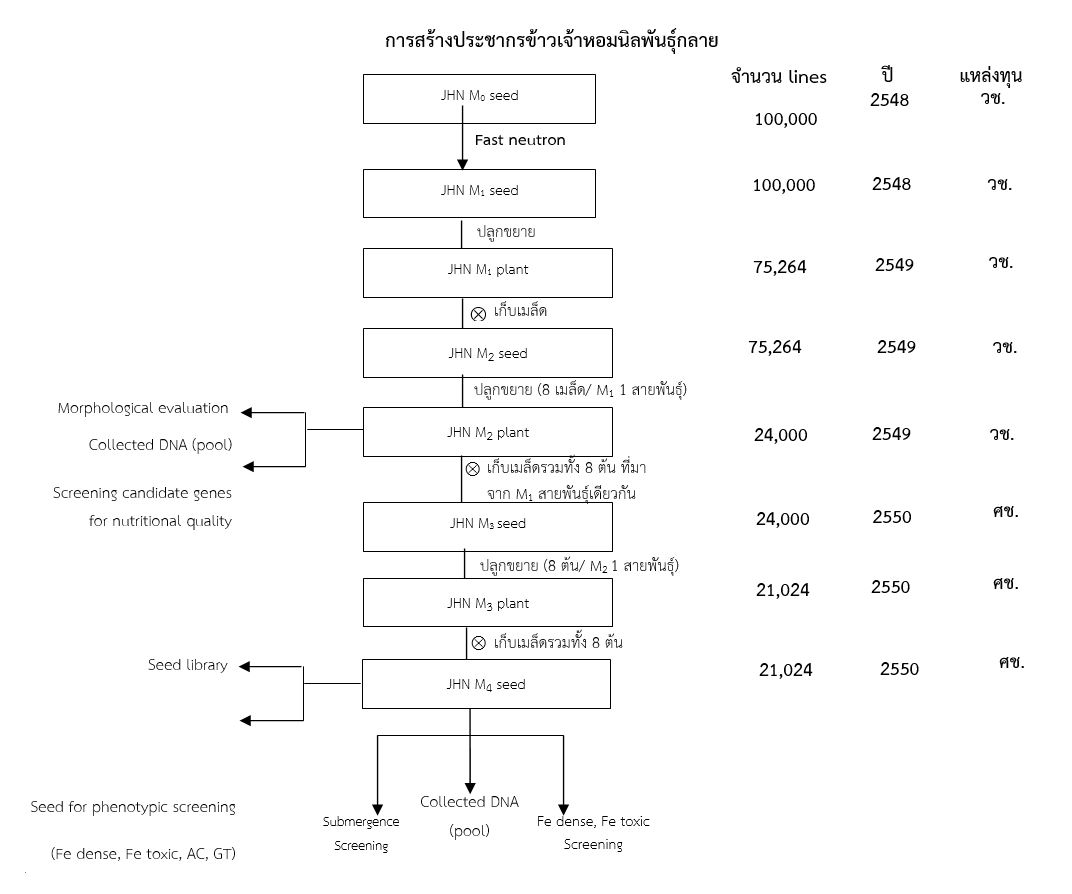
Diagram of creating and maintaining the Hom Nin mutant rice population
Approach to finding mutant genes
Because mutagenesis occurs across the whole genome, finding mutant genes is not easy. Today whole-genome sequencing can be done at an acceptable cost, so this leading-researcher grant will use Next Generation Sequencing (NGS), which we believe will make leaping to target genes not difficult. Together with developing an effective forward screening system that can screen mutant rice showing traits that have changed from the pre-mutation variety, finding associations with Single Nucleotide Polymorphisms (SNPs) is an appropriate way to find the functions of mutant genes across the whole genome, along with techniques for rapidly discovering the functions of individual genes.
The target mutants whose gene functions are to be found include mutants with sudden submergence tolerance, high iron and tolerance of iron toxicity, mutants with altered starch properties and aroma, mutants that can set seed under high temperature, and screening of new mutant lines that can set seed under water deficit, cold weather and saline soil. This leading-researcher grant will build a database of the genome codes studied so that researchers can benefit and access this valuable genetic resource.
To test the hypotheses, the leading-researcher grant will take these mutants and develop them into prototype lines that stack more than 20 gene loci for resistance to disease and insects, flash flood tolerance, acid soil tolerance and high iron, able to maintain yield under the coming global warming.
Objectivesof the leading researcher project
- Find mutant rice useful for developing fragrant rice with quality, nutrition and environmental friendliness
- Find the functions of the genes that cause mutations, focusing on screening discovered mutants and a new target: adaptation at the heading stage in cold weather, water deficit and salinity, using them to find genes and functions. This is the first time a mutant rice population adapted to changing climate will be screened.
- Stack useful genes to develop environmentally friendly rice
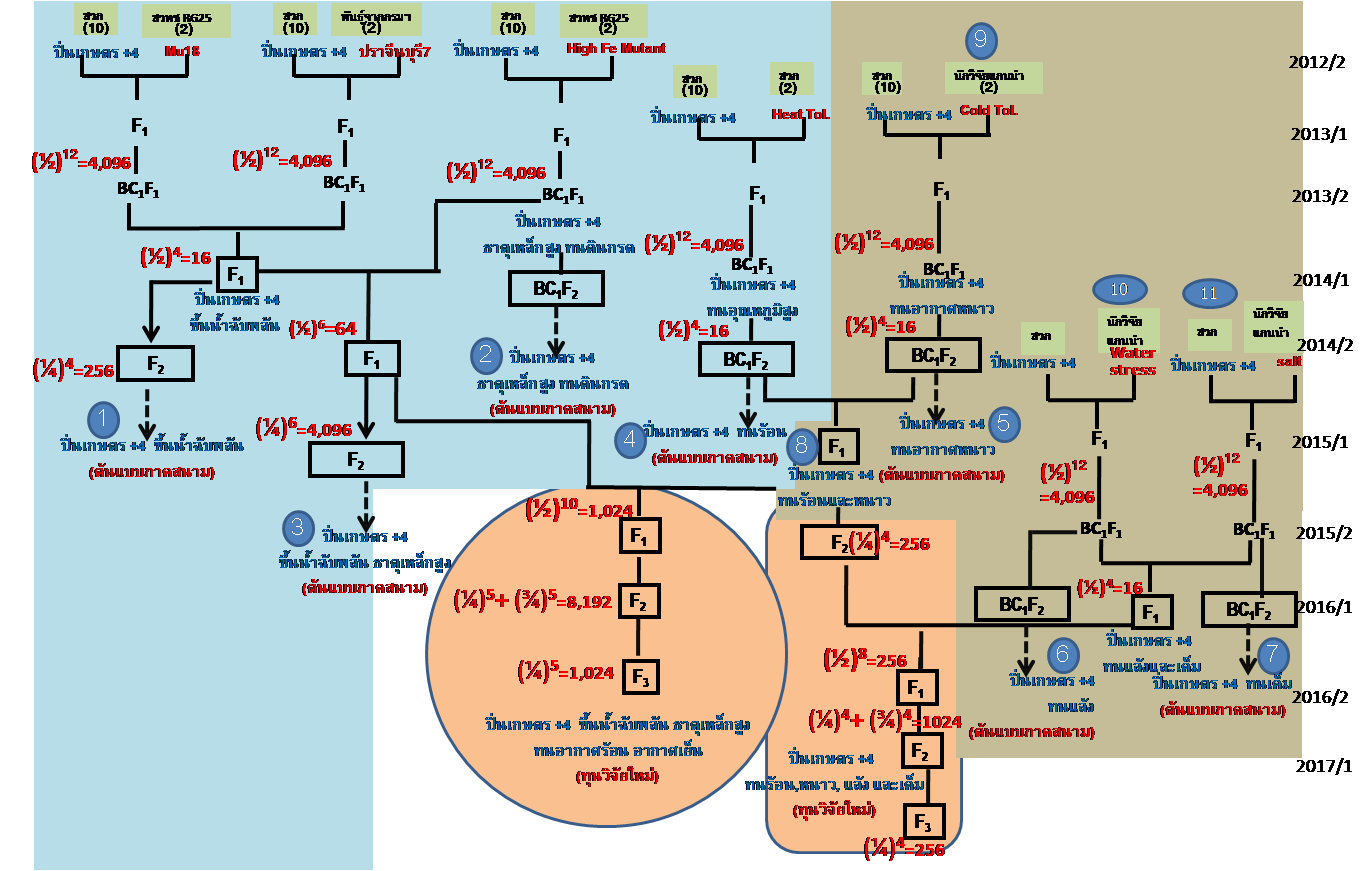
A gene pyramiding system must be developed to be as fast and efficient as possible, so that precisely bred rice can be created continuously. This builds on Pinkaset+4, a high-yielding rice that has stacked 2 loci each for resistance to brown planthopper, bacterial leaf blight and blast, plus flash flood tolerance, to be extended by modifying the flash flood tolerance genes with a gene group that makes rice elongate quickly under water, with high iron and tolerance, able to set seed under stress (water deficit, saline soil, cold and extreme heat).
Find useful mutant rice > Find the functions of mutated genes > Stack them for pyramiding
Sub-research group 1 Mutant Discovery
This is a good opportunity to screen mutant rice that resists sterility under water deficit, cold weather and saline soil, because mutant rice is uniform in flowering date, height and biomass. Following the success of the heat-tolerant rice breeding project (funded by ARDA), Assoc. Prof. Dr. Poonpipope Kasemsap and Asst. Prof. Dr. Chanate Malumpong took this mutant population of 12,000 lines to screen for seed set under global warming, and succeeded in finding mutant rice that sets seed even at very high daytime temperatures. Using the same 12,000-line population to compare tolerance of cold, water deficit and saline soil will be an interesting comparative study.
The activities consist of screening mutant lines tolerant of cold weather at the germination and seedling stages, and at the booting, heading and ripening stages, at the rice experiment station at the University of Phayao, Mueang District, Phayao Province, and screening mutant lines tolerant of water deficit and saline soil at the flowering stage in greenhouses that can adjust temperature and other microclimates to control rice growing under stress efficiently.
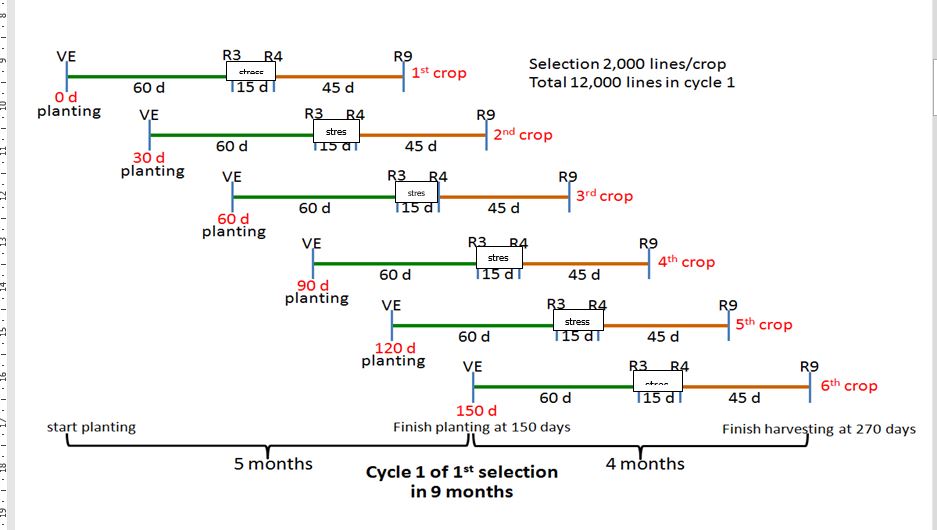
Diagram of the staggered planting plan to select lines tolerant of water deficit and saline soil at the reproductive stage for 12,000 lines, which will take at least about 9 months (6 crops) for each trait (water deficit and saline soil
Research groupsub-group 2 Functional Discovery
The targets for choosing technology to find genes and SNPs, including proving gene function, can be divided into two levels: previously identified mutants, namely sudden-submergence mutants, high-iron and iron-toxicity-tolerant mutants, starch-trait mutants, and mutants that can set pollen under high temperature, found in the earlier project but whose controlling genes have not yet been fully found and so must be pursued in this project; and newly identified mutants, namely target mutants that set seed under water deficit, saline soil and cold weather, which have been physically verified in sub-project 1.
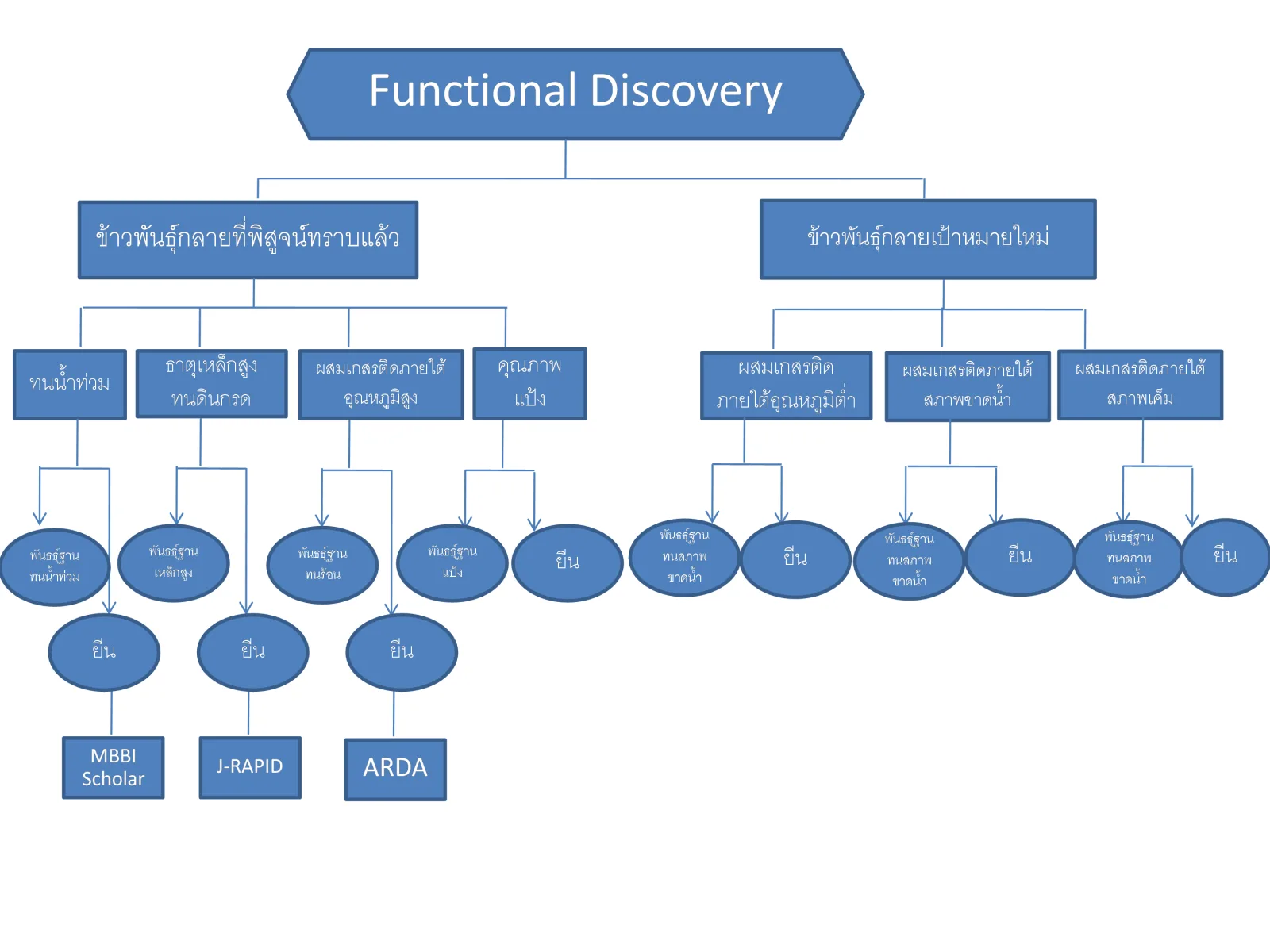 Diagram of the targets for choosing technology to find genes and SNPs, including proving gene function, which can be divided into two levels depending on how clearly they have been verified physically. Previously identified mutants include flash-flood-tolerant, heat-tolerant, altered-starch-quality, high-iron and iron-toxicity-tolerant mutants, and so on. Newly identified mutants include target mutants with drought, cold and salt tolerance, and so on, which have been physically verified in sub-project 1.
Sub-research groupNo. 3 Gene Pyramiding
Crossing and selecting environmentally friendly irrigated rice, using Pinkaset+4, which has already been given resistance to bacterial leaf blight, brown planthopper and flooding (ARDA funding), as the recipient line in backcross breeding, adding heat tolerance, cold tolerance, water-deficit tolerance, saline-soil tolerance, sudden-submergence flood tolerance, high iron and iron-toxicity tolerance to Pinkaset+4.
Expected results
Field-level product prototypes
Prototype rice for sudden submergence, high iron with strong acid soil tolerance, rice tolerant of heat, cold, drought and salinity at the heading stage, and environmentally friendly rice by gene stacking for water, iron, heat, cold, drought, salinity, disease, insects and cooking quality.
Prototypetechnology
Newly developed functional marker sets specific to the target mutants that make selection clearly more efficient.
New processes
- Processes and pathways controlling the work of genes related to deep and sudden flood tolerance, control of seed set in rice under global warming, aroma compound formation in rice, and starch synthesis
- Highly efficient gene pyramiding process
Public benefits
Transfer of technology for producing prototype rice seed and highly efficient rice breeding
Workforce development
Produce 6 master's students, 3 doctoral students and 2 postdoctoral researchers
Patents/petty patents/copyrights/trademarks
- Copyright: functional markers specific to seed set under global warming
- Patent: technology for breeding rice that can rapidly elongate under submergence
- New plant variety (PVP)
The leading research grant aims to do research together with other research groups, especially abroad, to deepen the knowledge to an international level, working with expert research groups abroad.