This device has no English text-to-speech voice, so the article may not be read aloud.
9 January 2020, 10:00
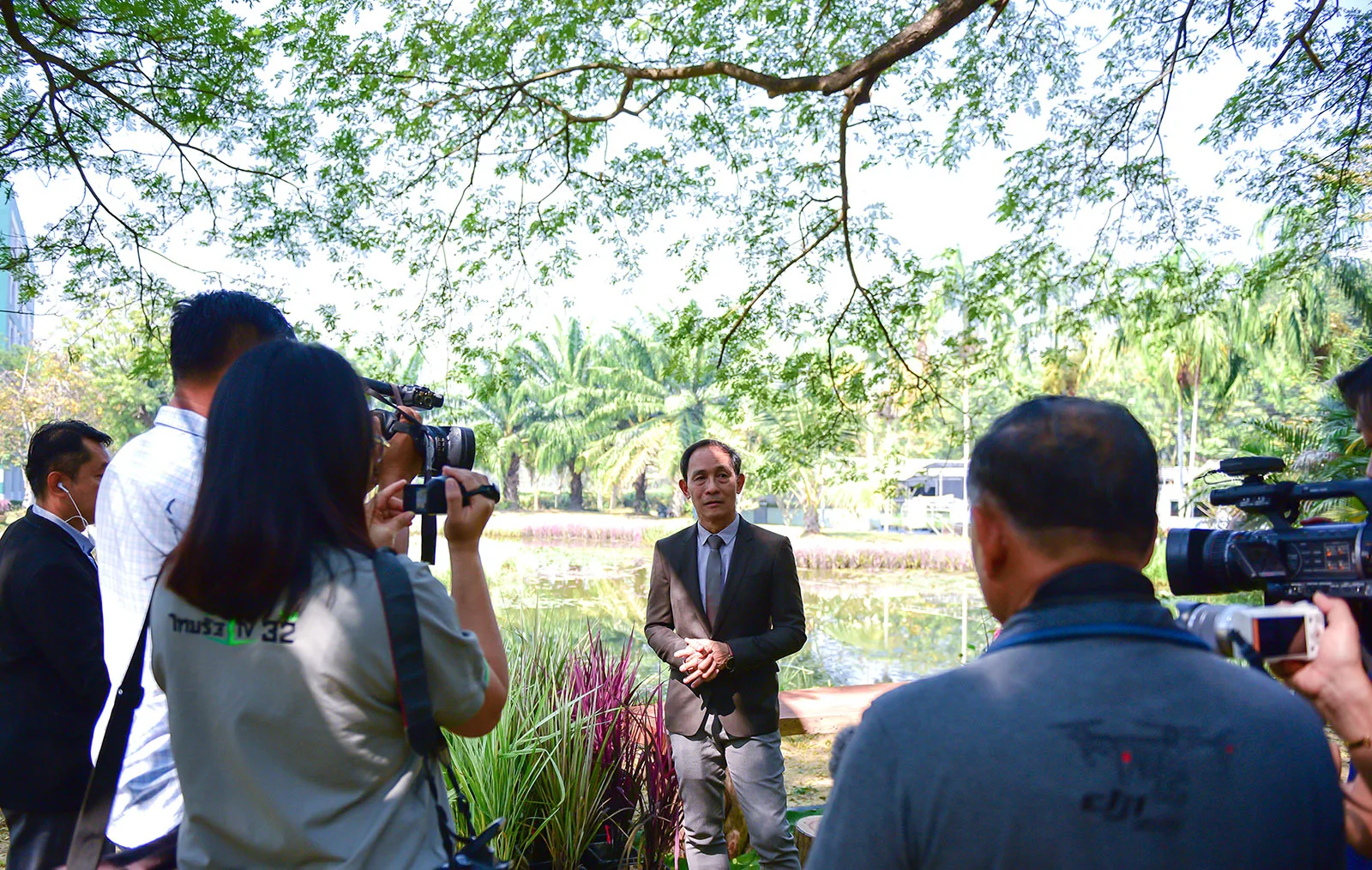
Prof. Dr. Apichart Vanavichit, Director of the Rice Science Center, Department of Agronomy, Faculty of Agriculture at Kamphaeng Saen, Kasetsart University, Kamphaeng Saen Campus Rice with pink leaves said to be a mutant from a Riceberry field in Phitsanulok Province: "It did not come from Riceberry rice", so a press conference was held to clarify.
A news report was issued about the discovery of a rice mutant from Riceberry in 2013, selected 4 times until it consistently became rice with purple-pink leaves on the whole plant. The Rice Science Center, Kasetsart University, and the Rice Gene Discovery Unit, National Center for Genetic Engineering and Biotechnology, have jointly developed Riceberry rice with funding from the National Research Council of Thailand (NRCT) since 2002, and it has been registered for new plant variety protection. The discovery is admirable and striking to those who see it, and lets Thai people, especially young people, see the beauty of rice very well.
However, the assumption that these rice plants are mutants of Riceberry contains many scientific inaccuracies. Mutation arises from 2 causes: naturally (spontaneous mutation) and induced (induced mutation) using radioactivity, chemical mutagens or genetic engineering. The first occurs at a very low rate and takes a long time to accumulate mutations until a new trait appears. Natural mutation usually keeps the traits of the original line, and decoding the genome shows it to be very similar to its original variety, as in the appearance of red Hom Mali rice from Hom Mali 105 at the Phitsanulok Rice Research Center. Induced mutation, by contrast, uses radiation or chemicals to make the genome mutate rapidly and drastically, allowing breeders to select mutants, both good and bad; for example, glutinous rice RD6 and RD15 arose through gamma ray irradiation, and decoding their genomes shows much greater differences from the original genetics.
Another important characteristic of induced mutation, as opposed to natural mutation, is that it takes a long time to build stability and uniformity. From the pictures in online media, the rice shows high uniformity in a very short time, enough to multiply seed in large quantities. Riceberry rice came from a cross between Hom Nil non-glutinous rice and Khao Dawk Mali 105; no mutagen has ever been used, and it was selected for uniformity and stability until it received new plant variety protection. The Rice Science Center, which has been assigned by the NRCT to multiply the prototype seed all along, has never found a rice mutant of this kind. The important step is checking the genetic material (DNA).
The Rice Science Center therefore hypothesizes that rice with purple-pink leaves on the whole plant arises from seed that does not meet standards, containing a few seeds mixed in from rice lines with this trait; if these are not removed during the plant multiplication process, they can multiply until they become visible. Importantly, this purple-pink rice is not like Riceberry at all, from the shape of the clump and leaves to flowering date, harvest date, cooking quality and disease resistance, which differ clearly.
Where do these beautiful rice plants come from? The Rice Science Center and the Rice Gene Discovery Unit have used a Fast Neutron irradiation process since 2009, using 100,000 Hom Nil non-glutinous rice seeds, and built a library of more than 20,000 fairly stable mutant lines. During that time no purple-pink leaf rice was found, but leaves with white longitudinal stripes between the green veins appeared and were separated out until uniform, named white-striped Hom Nil non-glutinous rice. Our breeders have crossed the white-striped Hom Nil non-glutinous rice since 2006 with a rice with purple leaves on the whole plant, Kam Hom Nil, a hybrid of Doi Saket Kam rice and Hom Nil non-glutinous rice, selecting appearance, color shade, pattern and leaf shape suitable for ornamental use, and named it “Rainbow Rice”. In the first phase, 5 stable lines were developed in 2013. The Rainbow Rice lines have leaves that are purple and pink on the whole plant.
The Rice Science Center believes that the purple-pink leaf rice found in the Riceberry field came from mixing with Rainbow Rice, not from natural mutation, because purple-pink rice has never been found anywhere before, even from native Kam rice with dark purple on the whole plant, where this has never occurred. This rice is therefore the result of crossing and selection by breeders only. Saying it is a mutation of Riceberry is thus truly hard to believe.
In terms of variety ownership, the discoverer may seek advice from the Plant Variety Protection Division, Department of Agriculture, which oversees access to general native plant varieties and new plant varieties, as well as the Plant Seed Research and Development Division, Department of Agriculture, before legally selling the seed.
Photo of the Rainbow Rice breeding steps

{os-gal-12}