This device has no English text-to-speech voice, so the article may not be read aloud.
“Thunya Sirin”: A New Glutinous Rice Variety with a Royally Bestowed Name
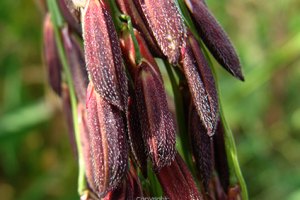
On 1 December 2010, Her Royal Highness Princess Maha Chakri Sirindhorn bestowed the name “Thunya Sirin” on a rice developed by the Rice Gene Discovery Unit, National Center for Genetic Engineering and Biotechnology (BIOTEC), National Science and Technology Development Agency (NSTDA), Kasetsart University, together with the Rice Research and Development Bureau of the Rice Department and Rajamangala University of Technology Lanna. The blast-resistant glutinous rice line was developed using molecular markers in selection together with standard breeding methods, giving a glutinous rice whose quality is close to RD6 but with blast resistance. Development began in 2002 and took about 4 years.
On 15 December 2010, Dr. Weerachai Weeramethikul, Minister of Science and Technology, and Dr. Theerayut Toojinda, researcher of the Rice Gene Discovery Unit, BIOTEC, jointly gave a press briefing on the royal kindness of Her Royal Highness Princess Maha Chakri Sirindhorn in bestowing the name “Thunya Sirin” on the new glutinous rice variety, from “Thunya”, meaning rice, and the name “Sirindhorn”. It is the first rice variety to be named by Her Royal Highness.
The glutinous rice variety RD6 is the main one grown, and most of the glutinous rice we eat is this variety. But it is a weak variety that is prone to blast, the main problem in rainfed areas, causing widespread damage every year and affecting food security and farmers' income. Biotechnology was therefore applied to improve RD6 by developing genetic markers that control the key trait, blast resistance, and some of the resulting seed was distributed to farmers for planting. This line's outstanding features are a strong stem that resists lodging, a yield of 800 kg per rai, and fewer broken grains, and in organic plots it can yield up to 1,000 kg per rai.
So far, Thunya Sirin seed has been trial-planted in farmers' fields in 5 provinces — Nan, Chiang Rai, Lampang, Chaiyaphum and Sakon Nakhon — in place of the original RD6 over 3 years, and was found to reduce damage in the fields by as much as 30%.
biotec.or.th