This device has no English text-to-speech voice, so the article may not be read aloud.
Summary of the discussion on “Growing Thansirin glutinous rice in Nong Khai and Bueng Kan provinces”, 12 March 2013, Rom Sai Meeting Room, Nong Khai Provincial Administrative Organization
9:00–9:30: Participating farmers arrived and registered, including farmers who received Thansirin rice seed last year and farmers interested in joining this discussion, from Nong Khai and Bueng Kan provinces. A total of 60 farmers took part.
9:30: Mr. Somkid Bannarak, Deputy Chairman of the Nong Khai Provincial Administrative Organization, gave the opening speech. After the opening, the first topic began: problems and obstacles in growing Thansirin glutinous rice. It started with watching the video Einstein and Village Headman Lee, episode on the new glutinous rice variety "Thansirin" resistant to blast disease (Figure 3), followed by a discussion with farmers who grew Thansirin in the last wet season. Some farmers had problems pulling out the seedlings for transplanting, some found the seedlings hard to pull, and some wanted plants 30 centimeters shorter than Thansirin, but most had no problem growing this variety because the stems are strong, the plants do not lodge, there is no blast disease, and harvesting is easy.
Variety acceptance and distribution of Thansirin glutinous rice: most farmers in Nong Khai accepted this variety because of its good yield (about 650–800 kilograms/rai) compared with RD6, which yields about 500 kilograms/rai, because the stems are strong and do not lodge, harvesting is easy, there is no blast disease, and the cooked rice is soft like RD6. Most of the harvested seed was given to relatives and neighbors nearby. Some farmers sold the seed at 20–25 baht per kilogram.
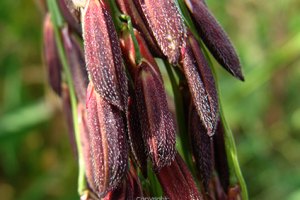
In Bueng Kan Province, seed was given to the Bueng Kan District Agriculture Office, which ran it at the Ban Na Kham Community Rice Center, Khok Kong Subdistrict, with 20 farmers. At first there were problems with acceptance, so the seed was distributed to 4 farmers (30 kilograms of seed each). Thansirin seedlings are dark green and easy to pull, no blast outbreak was found at the seedling stage, tillering was better, height depended on the area and fertilizer use (similar to RD6), and there was no lodging. It yielded 650 kilograms/rai at 14% moisture, more than RD6 (480 kilograms/rai), and was harvested one week earlier than RD6, with whole grains when milled. Harvest labor could be hired because harvesting did not coincide with RD6, and the rice did not lodge. Straw-colored grains (similar to non-glutinous rice, caused by grain moisture) were found. The community rice center bought back 3 tons of seed and collected it for resale to other interested farmers in Khok Kong Subdistrict; there were many orders, but only 3 tons could be bought back and sold. In the afternoon, there was teaching on using microbial technology (fermented liquid) to increase yield and reduce chemical costs, and on methods of checking seed quality by testing purity, moisture and germination, to prepare seed for the coming wet season.
Questions from farmers
1. Single-seedling planting versus multi-seedling planting: which gives a higher yield?
Answer: With single-seedling planting, the rice tillers more (possibly up to 42 stems, depending on the soil). Single-seedling planting gives at least 10% higher yield than multi-seedling planting and uses less seed. Most farmers plant several seedlings because they fear snails will eat the rice, but in fact planting several seedlings creates shade, which is a habitat for the crabs and snails that damage the rice.
2. What age of seedlings is best for transplanting?
Answer: For careful rice planting, consider the number of leaves: 3–5 leaves, with dark green, strong, disease-free seedlings whose roots do not break easily when pulled, which will tiller well. Older seedlings with more than 5 leaves tiller less.
3. Which growing method gives the highest yield: broadcasting, throwing seedlings, or transplanting?
Answer: Transplanting takes much labor, the rice tillers a lot, gives good yield and uses little seed (about 1–3 kilograms/rai). Broadcasting uses little labor and the rice tillers less, so it needs a lot of seed (about 30 kilograms/rai), wasting seed, fertilizer and weed control (though labor cost is low). Throwing seedlings means raising seedlings in trays and throwing them to save transplanting labor; only about 25,600 seedlings/rai should be thrown, depending on skill in throwing to get suitable spacing.
4. After keeping rice seed for 2–3 years, the rice mutates. If good seed is kept, will it mutate?
Answer: If the quality of rice growing and seed production is controlled (removing off-type plants at every stage), seed can be kept for many years (a single off-type seed will result in 2,000 off-type seeds per plant the next season). But some farmers keep seed for their own use without removing off-type plants, so there are mixed rice plants in the field, which farmers mistake for mutation, and so they change seed every 3 years by buying seed from the provincial or district agriculture offices at 20–25 baht per kilogram.