This device has no English text-to-speech voice, so the article may not be read aloud.

Rice growing has gone hand in hand with Thai culture for more than 5,500 years. Important historical evidence includes earthenware vessels used to hold rice. In the Sukhothai period, the stone inscription was recorded with the words "There are fish in the water, there is rice in the fields." Most importantly in history, free trade with foreign countries in the Ayutthaya period meant that rice has played an important role as Thailand's export product ever since.
Rice
is the seed of plants in the genus Oryza, found widely in Asia. Scientific name: Oryza sativa Rice is a cereal grain consumed as a staple food by the world's population, especially in Asia. According to 2010 data, rice is the second most widely grown cereal in the world, after maize.[1] Rice is the most important cereal in terms of human nutrition and caloric intake, because most maize is grown for other purposes rather than human consumption. Rice accounts for more than one-fifth of the energy consumed by humans worldwide.[2]
Genetic evidence shows that rice was domesticated about 8,200–13,500 years ago in the Pearl River valley region of China. Previously, archaeological evidence suggested that rice was domesticated in the Yangtze River valley in China. Rice spread from East Asia to Southeast Asia and South Asia. Rice was brought to Europe via West Asia, and to the Americas through European colonization.[3]
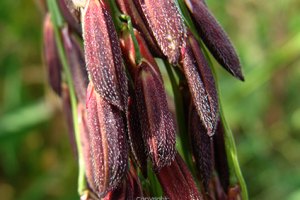
Rice is normally grown as an annual, but in the tropics it can live for several years and can be ratooned for up to 30 years. Rice plants can grow 1–1.8 meters tall, depending mainly on variety and soil fertility, with slender leaves 50–100 centimeters long and 2–2.5 centimeters wide. The hanging flower cluster is 30–50 centimeters long. The edible seed is a cereal grain 5–12 millimeters long and 2–3 millimeters thick.

Preparing soil for rice cultivation suits countries and regions with low labor costs and heavy rainfall, because soil preparation is labor-intensive and requires sufficient water. However, rice can grow almost anywhere, even on steep hills or mountainous areas using terraced water control systems. Although its ancestral species are native to Asia and certain parts of Africa, hundreds of years of trade and export have made it common in many cultures worldwide. The traditional method of preparing soil for rice is to flood the field for a period, or after the young seedlings are set. This simple method requires careful planning and the service of dikes and channels, but it reduces the growth of less robust seeds and of weeds that cannot grow while submerged, and suppresses pests. Although flooding is not necessary for preparing rice cultivation, all methods of irrigation require greater effort to control weeds and pests during the growing period and different methods of applying fertilizer to the soil.
Rice varieties
Oryza sativa is grown in every country. The species Oryza sativa can be further divided into
1. indica, grown mainly in the tropics
2. japonica, grown mainly in temperate zones
3. Javanica
By grain characteristics there are 2 types,
namely non-glutinous rice and glutinous rice, which are alike in almost every way but differ in the hard endosperm of the grain.
1. Non-glutinous rice grains contain about 15–30 percent amylose starch 2. Glutinous rice grains contain mostly amylopectin starch and about 5–7 percent amylose
By cultivation
By growing ecosystem, rice can be divided into 7 types:
1. Lowland rice: rice grown in paddies where water is impounded or can be held at a depth of no more than 50 centimeters. Lowland rice is grown in every region of Thailand and is divided into rainfed lowland rice and irrigated lowland rice.
2. Rainfed lowland rice: rice grown in the main season relying on natural rainfall, with water level uncontrollable, depending on rainfall distribution. Thailand has about 70% of its rice area as rainfed.
3. Irrigated lowland rice: rice that can be grown all year round in fields where water level can be controlled, relying on irrigation water. Thailand has 24% of its rice area under irrigation, and most of it is in the central region.
4. Floating rice: rice grown in fields flooded during growth, with water 1–5 meters deep for no less than 1 month. Floating rice is special in its internode elongation ability, upper nodal tillering and rooting ability, and kneeing ability.
5. Deepwater rice: rice grown in deep water areas, with field water more than 50 centimeters but not more than 100 centimeters.
6. Upland rice: rice grown on high ground or in upland conditions, on hillsides or areas without standing water, with no field bunds built to hold water.
7. Highland paddy rice: rice grown in flooded fields at elevations of 700 meters above sea level and higher. Highland paddy varieties must tolerate cold weather well.

Cooking
Many types of rice, for many purposes, are classified as long-, medium- or short-grain. Grains of aromatic long-grain rice (high amylose) tend to stay separate after cooking; medium-grain rice (high amylopectin) becomes stickier. Some long-grain types have high amylopectin; these are generally known as Thai glutinous rice and are usually steamed. Instant rice differs from parboiled rice in that it is fully cooked and then dried, with a significant reduction in flavor and texture. Cooking flour and rice flour are often used in batters and baking to add crispness.
Preparation
Whether or not to rinse rice before cooking depends on where the rice was produced. Most rice produced in the United States is enriched with vitamins and minerals (such as iron), which makes the rice look powdery. US rice is often labeled "enriched". If you rinse the rice afterwards, you lose these nutrients. Indian rice is not enriched, so rinsing is good for removing starch. In Japan, they rinse until the water runs clear, saying this helps the rice cook more evenly and taste better. Once rice has been rinsed it may be rinsed again, or soaked for 30 minutes. Soaking also reduces cooking time, saves fuel, minimizes exposure to high temperatures and thus reduces the stickiness of the rice. For some varieties, soaking improves the texture of cooked rice by increasing grain expansion. For example, a nutritionally superior method for preparing brown rice, known as GABA rice or GBR (germinated brown rice), may be used. This involves soaking rinsed brown rice for 20 hours in warm water (38 °C or 100 °F) before cooking it. This stimulates germination, which activates various enzymes in the rice. By this method, according to research conducted for the United Nations International Year of Rice, it is possible to obtain a more complete amino acid profile, including GABA.
Rice is cooked by boiling or steaming and absorbs water during cooking. It can be cooked in just as much water as it absorbs, or in a large amount of water that is drained off before serving. Electric rice cookers, popular in Asia and Latin America, make cooking rice easier. Rice (or any other grain) is sometimes quickly stir-fried in oil or fat before being boiled (as in saffron rice or risotto). This makes the cooked rice less sticky and is a cooking style called pilaf in Iran and Afghanistan, or Biryani (Dam-pukhtak) in India and Pakistan.
Nutrients and nutritional importance of rice
Rice is the staple food of more than half the world's population. Rice is the main energy source for the population of 17 countries in Asia and the Pacific, 9 countries in North and South America, and 8 countries in Africa. 20 percent of the world's energy supply comes from rice, with 19 and 5 percent from wheat and maize. Detailed analysis of the nutrient content of rice shows that its nutritional value varies with several factors, depending on the rice variety, among white, brown, red and black (or purple), with varieties widespread in different parts of the world. In addition, the nutrient quality of rice depends on the growing area and the way the rice is processed before consumption.

References
- FAOSTAT. Retrieved December 26, 2006.
- Smith, Bruce D. (1998) The Emergence of Agriculture. Scientific American Library, A Division of HPHLP, New York, ISBN 0-7167-6030-4.
- Page 7, Humans have farmed rice for almost 10,000 years. "Tan Lok". Thai Rath, Year 67, Issue 21342: Monday 27 June 2016 (B.E. 2559), 8th waning day of the 7th lunar month, Year of the Monkey
- The analysis of Thai rice problem : Ph.d. Aat Pisanwanich and others History of Thai rice : In-depth Institutional Repository of Rice The position of Thai rice in AEC : Post Today
Source: https://th.wikipedia.org/wiki/ข้าว