This device has no English text-to-speech voice, so the article may not be read aloud.
History and Background
http://dnatec.kps.ku.ac.th
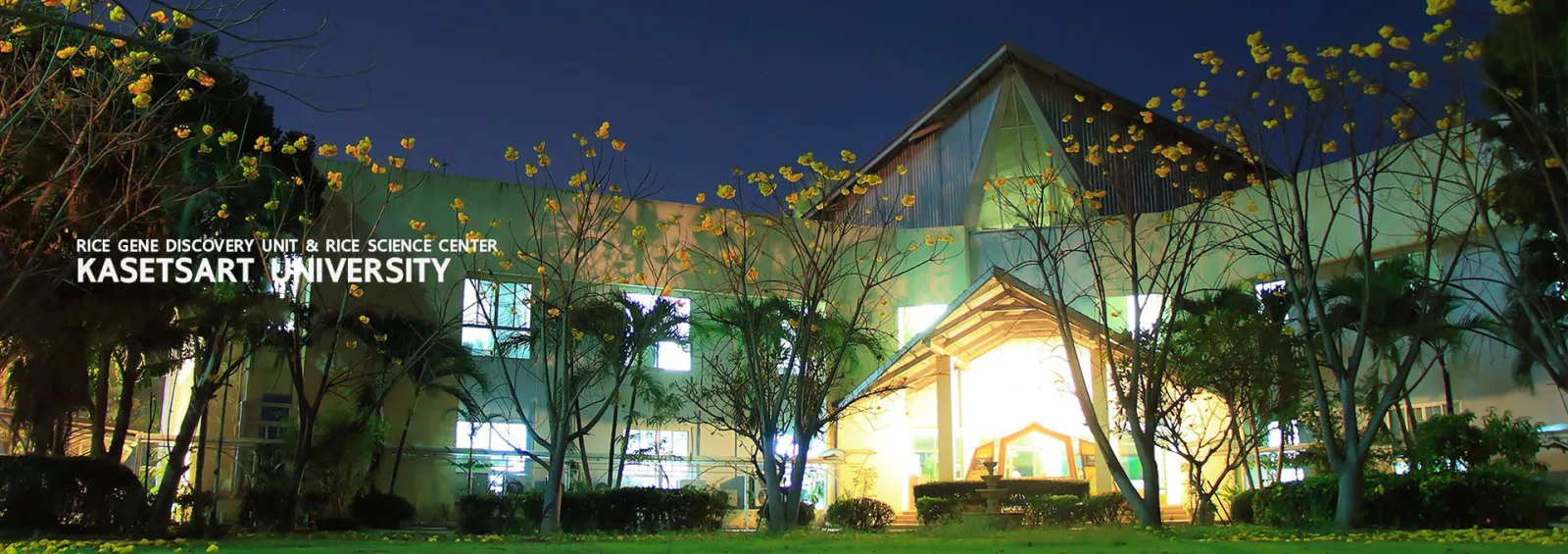
The Rice Science Center is an internal unit of Kasetsart University, established by the university's announcement on the establishment of the Rice Science Center dated 3 November 2005. It coordinates rice research and breeding work from upstream through midstream to downstream, strengthening it and developing it toward academic excellence, while seeking collaboration, especially from the National Center for Genetic Engineering and Biotechnology (BIOTEC), to support the Center's operations and other tasks assigned by Kasetsart University.
The Center consists of the Secretariat Office, the Research Laboratory and Rice Breeding Innovation Division, the Biotechnology Services Division, and the Production Innovation Promotion and Extension Division. The Center's specialized laboratories make up 9 joint laboratories with all the components needed as tools to make breeding more precise and faster.
VISION
The key goals are Super Nutrient Rice, Rainbow Rice, Climate-ready Rice, and the development of rice varieties with an optimal root system (Rhizo-root Rice), integrated with knowledge and molecular rice breeding to strengthen breeding capability through a Breeding-by-Pyramiding approach.
MISSIONS
- To be a hub for domestic and international collaboration that strengthens the capability to develop rice varieties precisely and quickly
- To develop fragrant rice, glutinous rice and colored rice varieties of premium quality, with therapeutic nutritional value and good resistance to disease, insects and global warming
- To develop a genetic base ready for breeding, for the quality, nutrition and yield of fragrant rice, glutinous rice and colored rice
- To quickly discover genetic code differences, find genes and develop DNA markers specific to target traits, for precise variety development
Research and Development
Discovery of important genes and rice variety development To increase yield and quality, leading to sustainable rice production for the country and greater competitiveness in the world market. In creating rice varieties with excellent traits in both quantity and quality, breeders must consider not only traits that give high-quality yield but also the prevention of yield loss caused by disease and insects, and by unfavorable growing conditions such as flooding, drought, saline soil and acid soil.
The Center is also a unit that studies the mapping of genes for 16 economically important traits, using integrated linkage maps and genes from 12 populations. The Unit uses these genes as targets for breeding both rainfed and irrigated rice. For rainfed rice, the goal is to breed Hom Mali 105 and RD6 varieties that keep the cooking quality and aroma of the original varieties but have the desired properties, such as better resistance to disease and insects and greater tolerance of environmental stress. This strategy brings good genes together (gene pyramiding) in both varieties, and also aims to raise yield potential further. For irrigated rice, the emphasis is on increasing yield and the value of the yield, for example by increasing nutritional value and amylose content. This strategy makes use of gene discovery from mutations to create the ideal rice variety, and is the first attempt in Thailand to use such a strategy to obtain a good rice variety.
Structural genomics The Unit collaborated with the International Rice Genome Sequencing Project (IRGSP), taking responsibility for sequencing chromosome 9, and the complete rice genome sequence was discovered. This discovery has not only brought new rice varieties to farmers, but has also increased yields and produced ideal varieties with excellent traits for sustainable consumption worldwide for another century. Taking part in the project is not only a source of national pride but also another step toward the rice genomics era.
Gene discovery The Unit is conducting research to locate genes for 16 economically important traits, using two genes that control quantitative traits, the flood-tolerance gene and a gene related to aroma, as models for the study. It has built a large-fragment genomic library (BAC library) for Hom Mali 105 and FR 13 A for physical mapping and large-scale sequencing. It has now succeeded in finding the genes and is investigating their functions. It also aims to discover other genes related to resistance, development, response to the environment, and nutrition.
Bioinformatics (Rice Gene Thresher) A large sequence database called Rice Gene Thresher (http://rice.kps.ku.ac.th) has been built as a public rice database so that rice breeders and other interested people can search for information, for the greatest benefit. The database contains genome sequences of both japonica and indica rice, including rice genetic maps, molecular markers, EST and DNA sequences, predictions of gene roles and functions, and protein structures, leading to a better understanding of gene and protein expression.

Functional genomics About 60% of the open reading frames in the rice genome have unknown functions, so it is necessary to discover gene function (functional genomics). Two approaches are generally used: transgenic techniques, overexpression or RNA interference of the gene of interest, and the technique called TILLING (targeting induced local lesions in genomes). The Unit used this technique to induce genome-wide mutations with fast neutron irradiation at a dose of 13 Gy; 200,000 Hom Nil non-glutinous rice plants were induced to mutate by this method, and mutant plants were selected to lead to the discovery of rice gene functions.
Molecular Breeding Improving rice to higher potential requires knowledge of the relevant genome sequences, using a technique called Marker-Assisted Selection (MAS) to breed rice with good quality and high yield. An example of a variety successfully developed with this technique is Hom Mali Trilak rice, which has three traits: tolerance of flooding, resistance to bacterial leaf blight, and resistance to brown planthopper.