This device has no English text-to-speech voice, so the article may not be read aloud.
Every time a flood strikes, people in agriculture, especially rice farmers, suffer. Rice fields are always affected, and recovery takes a long time because, besides waiting for the next rainy season, a year later, to have enough water to grow crops, the rice growing process also has many steps, and there are several factors that lower yield per rai, all of which raise production costs for farmers!!
The Friends in Need (of PA) Volunteers Foundation, under the patronage of Her Royal Highness Princess Soamsawali and Her Royal Highness Princess Bajrakitiyabha, intended to find a crop variety that could build a future for those flood-affected farmers, and found that there is at least one rice variety developed and registered for new plant variety protection by Thais that fits the royal wish. This variety is called Rice Berry.Riceberry was bred at the Rice Science Center with cooperation from the National Research Council of Thailand (NRCT) and Kasetsart University, and was filed for new plant variety protection registration by Assoc. Prof. Dr. Apichart Vanavichit, Director of the Rice Science Center, Department of Agronomy, Kasetsart University, in 2007. It was then studied and grown until its cultivation could be promoted widely.
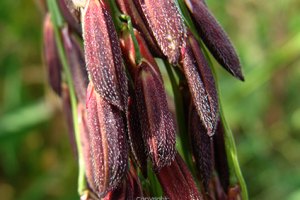
TheRiceberry rice variety was obtained by crossing Hom Nil non-glutinous rice with Khao Dawk Mali 105, so it is not black but red like a ripe berry (mulberry). The grains are slender and long; cooked as non-glutinous rice, it is dark purple, soft yet springy, with a slightly sweet taste and a distinctive aroma.
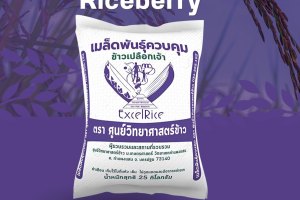
It is easy to cook, and the amount of water can be adjusted to taste, or it can be made into rice porridge. It can be grown all year round, is highly resistant to blast disease, and also tolerates iron toxicity in the soil. Studies have found that the darker purple the rice, the higher its antioxidant capacity, ranging from 35.3 to 214.7 umole/g by the ORAC (Oxygen Radical Absorbance Capacity) method; in particular, the bran of Hom Nil non-glutinous rice and Riceberry has a very high antioxidant capacity of 229–304.7 umole/g. When various rice lines are compared with ready-to-drink fruit juice or green tea, their antioxidant capacity is almost 100 times greater. Cooking dark purple rice in an electric rice cooker was found to reduce antioxidant capacity by about 50%, about half that of raw rice. Even so, purple rice still has higher quality and capacity than the ready-to-drink fruit juice or green tea sold in the market, and the darker the grain color, the higher the antioxidant effect. This research found that theRiceberry variety still retains antioxidants after cooking, which are not completely destroyed by heat, so it is a food source of high antioxidants. When the body gets enough antioxidants for its daily needs, it helps reduce the risk of diabetes, heart disease, vascular disease and cancer. As a result, the nutritional properties ofRiceberry ricethat consumers receive are high antioxidants in the grain, including beta-carotene, gamma-oryzanol, vitamin E, tannins, zinc and high folate, with a low-to-medium glycemic index. The bran and rice bran oil also have good antioxidant properties suitable for making therapeutic food products. Pregnant women who eat it benefit, especially the unborn child, who is the nation's future, because this rice contains folate, which can prevent cleft lip and palate, which would harm the child's future. Its low sugar helps mothers control their weight to avoid pre-eclampsia, and it is high in iron, which pregnant women need more than usual. People with diabetes and obesity who leave their condition untreated for a long time easily develop complications, lose opportunities and have shorter lives. But thanks to the properties ofRiceberry rice which has lower sugar than ordinary rice, if people with diabetes or obesity switch from ordinary rice to Riceberry, it helps control blood sugar and weight. People with iron-deficiency anemia who eat Riceberry regularly will get nutrients, especially natural iron, which helps nourish the blood and the body. The Friends in Need (of PA) Volunteers Foundation, together with Kasetsart University, the Bank for Agriculture and Agricultural Cooperatives (BAAC) and the Ministry of Commerce, promotes and supports growing and selling Riceberry rice by organic farming methods, and has the rice milled as brown rice at a rice mill certified for organic production, which is called Riceberry Friends in Need (of PA) rice. It is sold in easily degradable vacuum bags of 1 kilogram at 150 baht per bag, but from today until the end of April, the month of the elderly, it will be sold at a special member price of only 120 baht per kilogram. Those interested can support Riceberry Friends in Need (of PA) rice at the sales points: the Phon Phloi Phor Phiang Friends in Need (of PA) shop, BAAC district branches in every province, every branch of The Mall, and Big C Ratchadamri branch. Those who would like to taste Riceberry rice can try it at the Revitalite Healthy Life Management Center, Soi Ruam Rudi, and Uncle John restaurant, Suan Phlu Soi 8, or ask for more details by calling 08-1427-1347. Riceberry rice Friends in Need (of PA), besides helping build a future for farmers hit by the misfortune of floods, is also the rice of the future for consumers, with many health-promoting properties.
Source: www.dailynews.co.th