

This device has no English text-to-speech voice, so the article may not be read aloud.
Genes are the blueprint of life and are regarded as a priceless treasure for biotechnology and agriculture. Thailand joined the IRGSP to decode the rice genome, leading to the release of rice genome data in 2002 (B.E. 2545), making the rice genome the largest plant genome ever decoded to date.The rice genome is like the central core of the cereal genomes. Rice has the smallest genome among cereals, and many of its genes are found in other cereals. There are at least 3 reasons why scientists must decode the rice genome, to obtain complete, high-quality rice genome data.
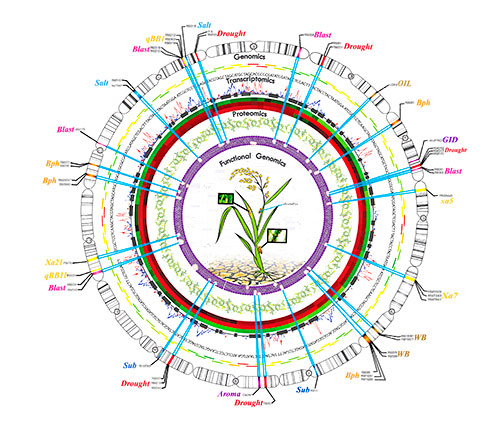
1. Finding out gene function requires precise and accurate rice genome sequence data. 2. Because rice is the model plant of the grasses, obtaining complete and accurate rice genome data will lead to new discoveries in other grasses. Understanding how economically important rice traits are expressed requires comparison on accurate and precise genome data.
Studying the expression of various traits in rice Genetic methods have produced data showing that certain regions on rice chromosomes influence various rice traits. In science these positions on the chromosomes are called quantitative trait loci (QTL). The main purpose of finding QTLs is to find the number, positions, control and interactions of the various loci that affect variation in rice traits.
After the rice genome data were released, gene annotation studies often led to the discovery of interesting genes within a region of a chromosome found to affect the expression of certain rice traits (QTL). Predicting gene functions often helps lead to selecting genes that may affect those rice traits. However, this gene selection step usually requires a great deal of data from conventional genetic and molecular experiments to support the decision. Data from various sources such as the pseudo-molecules, the rice genome annotation project, RAP1 (the international rice genome annotation project), studies of protein-protein interactions, and microarray data have been released and stored in public databases, with each type of data stored differently.