
This device has no English text-to-speech voice, so the article may not be read aloud.

The Rice Science Center, Kasetsart University, is a unit that plays an important role in research, testing and analysis services, promoting and transferring technology, and is also one of the best incubators of master's, doctoral and postdoctoral students. The current structure of the Rice Science Center consists of units doing research, development and technology transfer in biotechnology and plant breeding, namely the Rice Science Center under Kasetsart University, Kamphaeng Saen Campus, and the Rice Gene Discovery Unit supported by the National Science and Technology Development Agency (NSTDA), plus a part serving as testing and analysis services, consisting of the DNA Technology Laboratory under Kasetsart University and the Laboratory for Analyzing the Genetic Identity of Thai Rice for Export, a project under cooperation between the Department of Foreign Trade and Kasetsart University.
The Rice Science Center's outstanding achievements can be divided into main innovations: research innovation, technology transfer innovation and service innovation.
Research innovation andrice variety innovation The Rice Science Center focuses its research on rice breeding, applying DNA technology together with traditional crossbreeding. Economically important rice traits, whether cooking quality, nutrition, resistance to disease and insects, or tolerance of limiting environments, are controlled by genes or gene groups of varying number. Once researchers can develop DNA markers specific to a target gene or QTL, breeding can proceed using marker-assisted selection (MAS) and gene pyramiding. Each type of rice population created is monitored to confirm that the gene/QTL controlling the studied trait has been inherited from the donor using highly specific and accurate DNA markers, shortening breeding time and reducing work in the test plots compared with traditional breeding that relies on phenotype selection alone.
Outstanding work in rice variety development can be divided into two main goals: rice for food security, and rice fornutritional well-being
Rice for food security is rice that resists the important rice diseases and insect pests, as well as varieties tolerant of limiting environments, so these varieties can yield even under various disasters. This group includes photoperiod-sensitive lines with the cooking quality of Khao Dawk Mali 105 or glutinous RD6 for rainfed areas, and high-yielding photoperiod-insensitive fragrant rice for irrigated areas. Examples of outstanding varieties are as follows.

- Pin Kaset 1: Fragrant non-glutinous white rice with slender grains, aroma, high yield, photoperiod insensitivity, and cooked rice that is soft and sticky.
- Pin Kaset 3: White fragrant non-glutinous rice, photoperiod insensitive, high amylose, with a yield of more than 1 ton per rai.
- Hom Chonlasit: Irrigated rice with high yield, aroma, long grains and softness, but clearly different from Khao Dawk Mali 105 in cooked starch temperature. It can survive under water for at least 2–3 weeks and recover after the water recedes.
- Hom Mali 80: Khao Dawk Mali 105 with added flash flood tolerance, without any change in cooking quality.
- Hom Mali+4: White fragrant non-glutinous rice, photoperiod sensitive, with the cooking quality of Khao Dawk Mali 105, and tolerance of blast, bacterial leaf blight, brown planthopper and flash floods.
- Glutinous rice Thunya Sirin: RD6 glutinous rice that resists all types of blast disease very well.
As for rice fornutritional well-being, these new varieties have been bred with the objective of not only tasting good but also helping prevent nutrient deficiency, strengthening immunity against cancer, and reducing the incidence of diabetes, heart disease and high blood pressure. They are considered varieties that help solve the health problems of people today. Examples of outstanding varieties in this group are
- Riceberry: Deep purple non-glutinous rice, soft and sticky brown rice, rich in antioxidants such as beta-carotene, vitamin E, polyphenols and anthocyanins, preventing blood vessel blockage. Extracts from the bran of this variety have shown activity inhibiting the growth of test cancer cells, namely colon cancer, breast cancer and leukemia cells, and protecting against liver degeneration.
- Sinlek: White fragrant non-glutinous rice with highly bioavailable iron and a fairly low glycemic index of brown rice.
- Pinkaset+4: White fragrant non-glutinous rice, photoperiod insensitive, with a yield of more than 1 ton per rai, a low glycemic index of polished rice, and tolerance of blast, bacterial leaf blight, brown planthopper and flash floods.
- Hom Nuan glutinous rice: White glutinous rice with long grains and aroma, high iron bioavailability in both brown and polished rice, and a moderate level of rapidly available glucose, which is lower than glutinous rice on the market.
- Kam Hom rice: Black glutinous rice with long grains, aroma, high iron and a high amount of antioxidants.
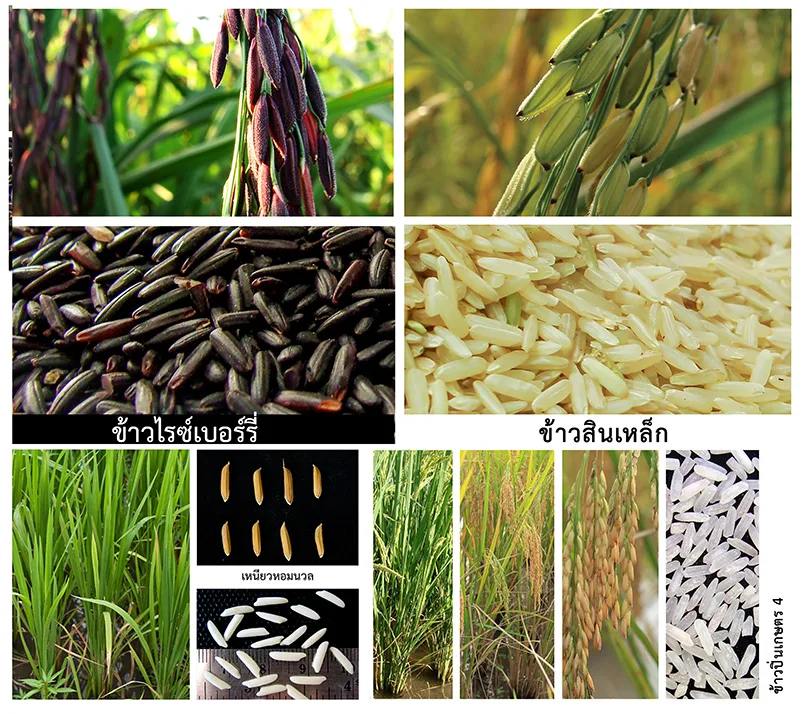
Images of examples of nutritional well-being rice: Riceberry, Sinlek, Pinkaset+4 and Hom Nuan glutinous rice
Core technology
The Rice Science Center has received funding to develop important world-class technology for research, including
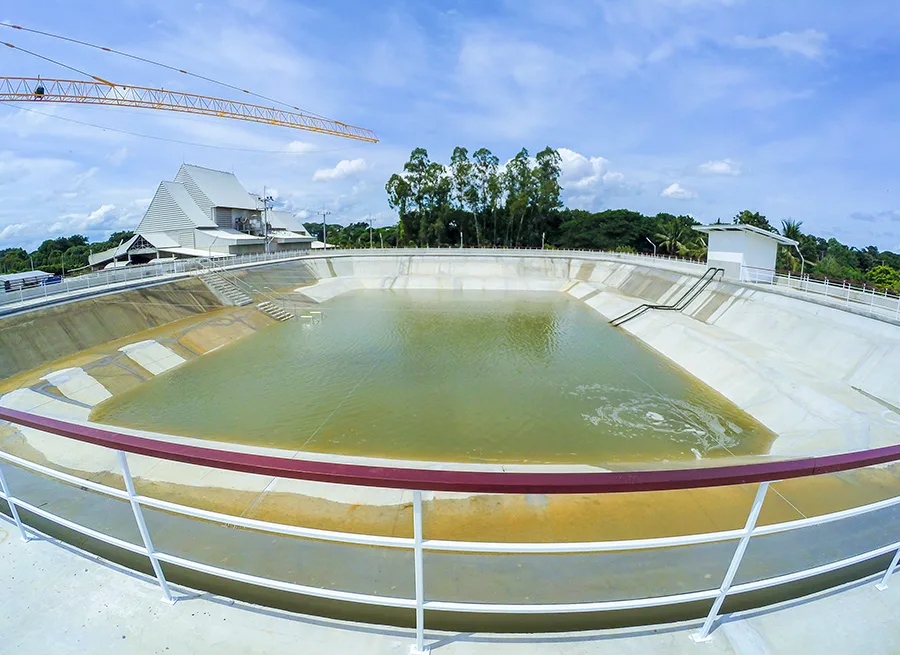
Rice testing station under flood disaster conditions (Deep Flooding Submergence Pool Facility), image above
The problem of global warming today means rice growing may suffer from undesirable climate conditions such as flooding. To cope with this disaster, KU, through the Rice Science Center, and the Ministry of Science and Technology, through the National Science and Technology Development Agency (NSTDA), jointly built a rice testing pool for deep flooding conditions. It is a concrete pool measuring 30 x 30 x 5 cubic meters with a crane for lifting rice pots up and down from the deep pool, used in research and in developing rice that tolerates prolonged flooding well.
Laboratory for rapid and precise advanced plant physiology and phenotyping (KU Plant Phenomics Center)

KU Plant Phenomics Center
The success of genomics technology in the past decade needs to be paired with a rapid and precise system for studying plant phenotypes. The Institute for Advanced Studies of Kasetsart University therefore funded the installation of a Plant Phenomics System at the Rice Science Center to analyze plant development and production potential under limiting environments.
Digital Seed bank
400 Thai native rice lines, together with 263 mutant rice lines with interesting phenotype databases, were selected for whole-genome sequencing by applying NGS together with the convenient and rapid ddRAD sequencing (double-digested restriction-site associated DNA sequencing) technique, leading to the discovery of more than 1,500 SNP positions and the construction of genetic diversity charts, which found that rice lines can be clearly separated into groups. Sequencing diverse rice genomes builds a path to quickly finding genes controlling variety-specific quality and other good traits.
Training research personnel From the past to the present, the Rice Science Center has produced 22 doctoral graduates and 31 master's graduates, including both Thai and foreign students. The unit has also played an important role in training researchers from neighboring countries under the rice research and development project using biotechnology under cooperation between the National Science and Technology Development Agency and Mekong basin countries, namely Myanmar, Laos and Cambodia.
Publications The research team from the Rice Science Center and the Rice Gene Discovery Unit has published 56 international papers with impact factors ranging from 0.946 to 41.456.
Intellectual property
Patents The patent on the rice aroma gene, titled Transgenic plants with reduced expression of Os2AP and elevated levels of2-acetyl-1-pyrrolinehas been granted in 11 countries: the United States, Australia, Japan, China, Vietnam, India, France, the United Kingdom, the Netherlands, Germany and Switzerland.
New plant varieties Riceberry and Sinlek rice, bred by the Rice Science Center, have been registered as new plant varieties by the Plant Variety Protection Office.
Trademarks The trademarks Thanyaosot, Riceberry and Sinlek have been registered at the Department of Intellectual Property, Ministry of Commerce, to certify the quality of high-nutrition organic rice produced and sold by the Thanyaosot mill, which must be controlled in production from paddy in farmers' fields to bagged rice reaching consumers.

Images of the registered trademarks
Technology transfer innovation
Promoting rice growing among farmers by building a rice production system through knowledge management, bringing in suitable technology with an emphasis on self-reliance in the form of a social enterprise that helps farmers recognize reducing production costs and promotes increasing standard organic rice quality, to develop the potential of Thai rice as grain medicine to the world's kitchen.
2009–2014: Project to promote complete organic high-nutrition Riceberry production from farmers to consumers, in cooperation between the Friends in Need (of PA) Volunteers Foundation and BAAC.
2015: Organic Riceberry project in cooperation with the Office of the Permanent Secretary, Ministry of Commerce

Image of Riceberry growing areas in the 2015 Organic Riceberry project
In addition, there has been transfer of community rice seed production technology together with the National Science and Technology Development Agency (NSTDA) for areas at risk of blast outbreaks, using the glutinous variety Thunya Sirin or blast-resistant RD6 from 2008–2015; transfer of community rice seed production technology in areas at risk of blast and bacterial leaf blight outbreaks (RD6 resistant to blast and bacterial leaf blight) in 2012–2015; and transfer of community seed production technology in areas at risk of flooding and drought, using the variety IR57514, tolerant of flooding and drought, in 2014–2015.
Service innovation DNA Technology Laboratory The DNA Technology Laboratory provides testing and analysis services, using DNA markers as a tool to test and solve various genetic problems that arise, and can also resolve legal problems accurately and precisely. Important analytical services include:
Testing for adulteration of Thai Hom Mali rice (SSR marker) Testing the purity of Thai Hom Mali rice for export according to the purity standard of no less than 92 percent set by the Ministry of Commerce, using SSRs that can distinguish Thai Hom Mali rice from other varieties in the database. Over 12 years, more than 50,000 rice samples have been tested for adulteration, equal to more than 8 million PCR reactions.
GMO testing Results can be reported both qualitatively and quantitatively at a detection resolution of 0.1% GMO contamination

Laboratory for Analyzing the Genetic Identity of Thai Rice for Export
A laboratory for testing the purity of Thai rice for export and for tracing fragrant rice from neighboring countries that may compete with Hom Mali rice. The laboratory operates as a “project under cooperation between the Department of Foreign Trade and Kasetsart University” and has adopted KASP SNPline Super high-throughput technology to test DNA identity rapidly, increasing the capability to check the identity of Thai rice and neighboring countries' export rice in the shortest time, at a low cost equal to using multiplex SSRs, able to process many samples with high accuracy using little DNA, and able to run 21,504 PCR reactions at once in 1 hour.
 Image of the equipment for testing rice variety purity by DNA identity using KASP SNPline Super High-throughput technology.