This device has no English text-to-speech voice, so the article may not be read aloud.
On 11 October 2010
Researchers of the Rice Gene Discovery Unit received the 2010 Outstanding Technologist Award from the Foundation for the Promotion of Science and Technology under the Royal Patronage of H.M. the King.
The unit is one of the best incubators of master's, doctoral and postdoctoral students, regarding all its students as the mechanism that continuously drives its research. The research carried out is entirely new initiative work that always requires learning, thanks to the unit's “interdisciplinary” nature. This allows genomics research using advanced technology to produce results that farmers and consumers can actually touch, making it a rare “biotechnology” bridge today.
The unit's work is widely accepted by academics, farmers and consumers. The unit is a leader in rice biotechnology research both in Thailand and abroad. As Thailand is the world's No. 1 rice exporter, the unit is like a key spearhead of the country in developing breeding technology that makes rice both fragrant and highly nutritious for the world market.
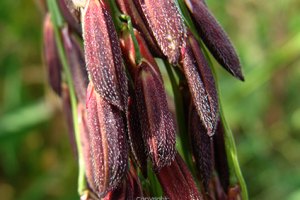
Prof. Dr. Sirirurg Songsivilai, Chairman of the Outstanding Technologist and Young Technologist Award committee of the Foundation for the Promotion of Science and Technology under the Royal Patronage of H.M. the King, announced the 2010 Outstanding Technologist Award winners, saying that this year's award goes to a team that created technology for enhancing jasmine aroma to improve the efficiency of breeding jasmine rice and glutinous rice, a technology that has been developed continuously for 12 years.
This research has led to advanced technology for breeding fragrant and glutinous rice, yielding as many as 8 new lines with outstanding traits, with added resistance to diseases and insects and the ability to grow in unfavorable environments such as drought-prone or saline areas. The technology also shortens breeding time and gives farmers the chance to grow new varieties such as Khao Dawk Mali 105 and fragrant glutinous rice RD6, which are now grown in large quantities, as much as 80%.
“The research of Dr. Apichart and team emphasizes plant breeding without genetic modification, or GMO, which is a current problem. The research team has also studied aroma genes in other plants, such as soybean, whose aroma is as outstanding as rice, for further breeding development,” said the committee chairman.
Assoc. Prof. Apichart Vanavichit, Head of the Center for Agricultural Biotechnology (Kasetsart University, Kamphaeng Saen Campus), said that rice breeders can now develop technology to find new rice lines by drawing out the outstanding traits of each line at the genetic level, or by differences in gene expression, known as Molecular Marker SNP, which speeds up finding new rice lines to 3 years, from more than 10 years previously needed to obtain one line.
“Technology makes rice breeding move forward quickly without the heavy investment of the past, because obtaining a new rice line used to require as much as 10 million baht, but the research can now find lines with several outstanding traits in a single line, a limitation that GMO techniques cannot overcome.”
Even though research funding stays constant, researchers knowing the genetic sequence and the differences of key rice genes will make future breeding processes faster, and in the long run the cost of developing rice lines tends to fall, by working with the Rice Department and the Bank for Agriculture and Agricultural Cooperatives to distribute rice seed to farmers.
“I aim to develop one rice line per year by 2012. In addition, the research team has worked with the International Rice Research Institute to decode the rice genome, increasing breeding capability without GMO techniques, and is also looking at aroma genes found in other plants, such as that of aromatic coconut, which I personally find interesting,” said the Outstanding Technologist Award winner.
At the same time, the Foundation for the Promotion of Science and Technology under the Royal Patronage of H.M. the King also announced the Young Technologist Award, given to technologists with outstanding work who are no more than 35 years old, to 3 recipients: Asst. Prof. Chotirat Ratanamahatana of the Department of Computer Engineering, Chulalongkorn University, for using dynamic time warping in data mining; Asst. Prof. Pimthong Thongnopkun of the Faculty of Gems, Burapha University, for developing nano silver clay production technology and techniques for forming silver jewelry from nano silver clay; and Asst. Prof. Yodyiam Tipsuwan of the Department of Computer Engineering, for building the Smart Doser, which mixes solutions using a microcontroller system, and developing industrial-scale livestock house control technology.
Outstanding Technologist and Young Technologist Award recipients will receive a Super Mod sailboat sculpture and medal, with prize money of 600,000 baht for the Outstanding Technologist Award and 100,000 baht for the Young Technologist Award, at the Thailand Science and Technology Conference on Tuesday 26 October 2010 at the BITEC Convention Center, Bangna.