This device has no English text-to-speech voice, so the article may not be read aloud.
Article by Prof. Dr. Apichart Vanavichit
From 2016 to 2019, Thailand's overall rice export volume fell by 32% while Vietnam's fell by only 9%. In particular, Thailand's fragrant rice exports (1.1 million tons) are lower than Vietnam's (1.9 million tons), so there is concern that the future of Thai fragrant rice will certainly not be bright. The key factors are, first, Thai fragrant rice yield (500–600 kg/rai) compared with Vietnamese fragrant rice (>1 ton/rai). Second, the price of Thai fragrant rice (1,190 USD/ton) is higher than Vietnam's (510 USD/ton). Third, Vietnamese fragrant rice matures much earlier than Thai fragrant rice. Today consumers often eat out, making restaurants important customers, and to cut costs restaurants prefer to order cheaper soft rice to serve customers.

| Table: comparison of harvest age, yield, grain size and aroma of rice transplanted in organic paddy fields | ||||||
| Rice variety | Harvest age (days) | Yield per rai (kg/rai) | Milled grain length (mm) | Milled grain width (mm) | Ratio | Aroma 2AP (ppm) |
| Hom Malai Man | 110-115 | 599 | 7.43-7.90 | 1.83 | 4.06 | 4.89 |
| Pathum Thani 1 | 120 | 496 | 7.34 | 1.97 | 3.72 | 2.1 |
| ST-24 | 110 | 264 | 7.25 | 1.72 | 4.22 | 4.3 |
Fragrant rice breeding in Vietnam is in the hands of a private company in Sóc Trăng, not the government. Vietnam has devoted itself to raising yield, grain size and excellent physical properties, so its production cost is much lower than Thailand's, and in 2018 the ST24 variety won first prize at the World's Best Rice contest, further worrying Thai jasmine rice exporters. For Thai soft fragrant rice to compete with Vietnamese fragrant rice, yield must be raised, or production efficiency increased at the same cost.
New soft fragrant rice varieties
To increase the efficiency of soft fragrant rice production, the Center of Excellence for Precision Rice Breeding for Food Security, Quality and Nutrition, a joint unit of the Rice Science Center, Kasetsart University, and the National Center for Genetic Engineering and Biotechnology (BIOTEC), has been selecting soft fragrant rice lines that resist disease and insects and tolerate flash floods, with high yield under sufficiency cultivation and sustainable cultivation, resulting in new short-duration, high-yielding fragrant rice lines coming to market.
Hom Malai Man is a soft fragrant rice with a high level of aroma, even when grown in the irrigated central region, with very slender grains up to 7.9 mm long. The milled rice is translucent, with a short harvest age (110 days transplanted, 95 days broadcast), is easy to grow, and adapts well with moderate resistance to disease and insects at the plot level. Hom Malai Man is being promoted for planting in the central and eastern regions to open the Chinese market and compete with Vietnamese fragrant rice. However, when compared with the yield of ST24 in a transplanted organic paddy system at the Rice Science Center, ST24's yield was half that of Hom Malai Man, with shorter grains and a similar aroma. ST24 is therefore unlikely to be a major competitor to Thai fragrant rice.
Precision agriculture to raise aroma
Consumers today feel that fragrant rice has become less fragrant. Developing new fragrant rice varieties that produce more aroma compounds is one part of the answer, but another part is stimulating the aroma-forming process through the planting season, fertilizer, nutrients, water and aroma-stimulating substances. Cool weather, water deficit and salinity during grain filling make rice more fragrant but lower yield, while chemical fertilizer aimed at maximum yield, on the contrary, reduces aroma accumulation in the grain. The Rice Science Center, together with the National Innovation Agency, has developed a way of growing fragrant rice to be more fragrant, called the aroma-stimulating technique. This technique can increase aroma accumulation by more than 30% in jasmine rice, while also increasing yield and rice quality at only a small added cost, making fragrant rice more desired by consumers and able to fetch higher prices.

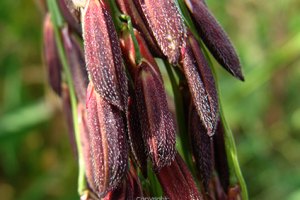
Images of rice lines developed through collaboration between the Rice Science Center and the Plant Biotechnology and Precision Agriculture Innovation Research Team (Center of Excellence for Precision Rice Breeding for Food Security, Quality and Nutrition)
Center of Excellence for Precision Rice Breeding for Food Security, Quality and Nutrition Kasetsart University, Kamphaeng Saen Campus
http://dna.kps.ku.ac.th
Marketing management of Thai fragrant rice
Thailand has two fragrant rice standards: Thai Hom Mali Rice and Thai Jasmine Rice. Thai Hom Mali Rice is produced from Khao Dawk Mali 105 and RD15, with strict requirements on physical and chemical properties and varietal purity (DNA test). Thai Jasmine Rice is produced from fragrant rice other than Thai Hom Mali, with looser requirements on physical and chemical properties, cooking quality and varietal purity. However, no standard has been set for soft rice without aroma. In the end, non-fragrant soft rice is mixed with top-grade fragrant rice, damaging the quality of Thai Hom Mali Rice. In many cases, soft rice with no market is mixed with hard rice, lowering the quality of parboiled rice, rice noodles and khanom jeen. To prevent soft rice from contaminating other types of rice, the government needs to set a standard for soft rice and market it to consumers who like soft rice, both at home and abroad, to raise the competitiveness of Thai rice in the world market.