
This device has no English text-to-speech voice, so the article may not be read aloud.
“Focused on developing breeding technology, building the identity of Thai rice, going far in world-class nutrition”
Article by Assoc. Prof. Dr. Apichart Vanavichit Director, Rice Science Center
Kasetsart University has brought advances in genomics technology to rice breeding, together with strengthening a new generation of rice breeders who see rice as more of a science. The benefit is that Kasetsart University, together with the national research institute the National Center for Genetic Engineering and Biotechnology (BIOTEC), has left several outstanding world-class works in completely decoding and interpreting the rice genome together with international partners, with the result that Thai rice breeding has quickly stepped into the next generation. Kasetsart University remains committed to breeding rice with specific value and high yield suited to processing and adding value for industry, which can also generate additional income for farmers.
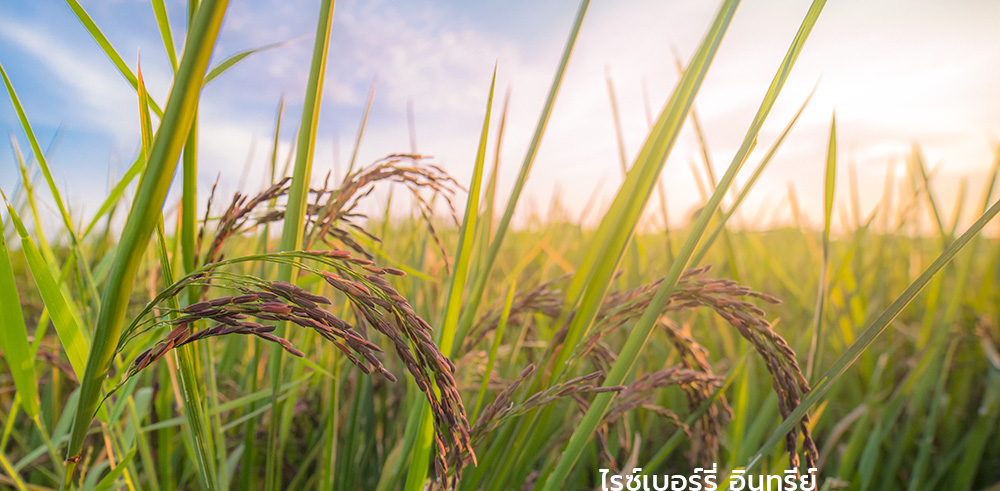
The starting point, in 2014, was Kasetsart University leading the breeding of brown rice for strengthening immunity called “Thanyaosot” (grain medicine), such as rice with high antioxidants, namely Sinin (Hom Nin non-glutinous rice) and Riceberry, and rice with high iron and a moderate glycemic index such as Sinlek. It cooperated with a leading nutrition institute, Mahidol University, in scientific nutritional-therapy studies of these high-nutrition rice products. Combined with outstanding texture and a striking color, Riceberry quickly became popular (supported by the National Research Council of Thailand).
During the same period, the Kasetsart University rice breeding team also created an irrigated fragrant rice variety that combines more than 10 gene loci in Pin Kaset+4 fragrant rice, which yields more than 1 ton per rai and has a lower glycemic index than the famous Indian basmati rice. Pin Kaset+4 fragrant rice will be a hope for farmers in irrigated areas who want a rice variety with a distinctive product identity that consumers want.
The first key
Growing rice as grain medicine is the key to the premium rice market, which can create the highest added value from the farmer's hands. Organic farming is a high-quality rice growing system because it is delicate and environmentally friendly and does the most to improve farmers' quality of life. Organic rice yield is therefore of a quality rich in micronutrients, antioxidants and metabolites that reinforce its natural strength. However, growing organic rice must start with farmers who have “ideals” to succeed. Unfortunately, many of these idealistic farmers have been destroyed by the rice pledging scheme.
 The second key
Establishing the Thanyaosot rice mill at Kasetsart University as a mid-sized processing center suited to the volume of Thanyaosot rice produced under organic farming (economy of scale) lets high-quality packaged rice products reach consumers continuously, creating a lasting impact on consumer behavior and continued market growth.
The third key
Developing specific marketing starting from positioning the product appropriately in the market, with key selling points of striking color, research on nutritional therapy value, together with the soft texture of brown rice and a unique aroma, which is why Riceberry now holds the highest position in Thailand's bagged rice market.
The fourth key
To keep the refined organic rice growing system sustainable, a fair socio-economic mechanism must be developed to drive the product to the premium market and pass marketing profit back to farmers and their communities. We therefore apply social business together with fair trade and contract farming to drive an organization made up of “government agencies” (the Bank for Agriculture and Agricultural Cooperatives (BAAC), the Marketing Cooperatives and the Land Development Department), “farmers” (community enterprises and various organic farmers), and “educational institutions and foundations” (Kasetsart University and the Friends in Need (of PA) Volunteers Foundation), which together developed the “Project to Promote Complete Organic Riceberry Growing from Farmers to Consumers”, modeled like a social enterprise. Currently about 3,000–5,000 rai of organic growing area is in the project, and a large area is outside it. More than 70% of the growing area is in the northeast, where farmers' average income is lower than in every other region.
Rice yield in irrigated areas faces the highest pressure from world-market competition. To give a new option, Kasetsart University has led the breeding of high-yielding, environmentally friendly rice with a nutritional-therapy identity, namely low-glycemic-index white rice (supported by the Agricultural Research Development Agency), designed so consumers who have trouble preventing type 2 diabetes turn to eating white rice or Pinkaset+4 processed products such as noodles, parboiled rice and various baked crispy foods. In human trials, the glycemic index of Pinkaset+4 was found to be clearly lower than that of basmati rice. With its slender grain size and shape, aroma, high yield and outstanding disease/insect resistance, Pinkaset+4 is attractive for building another social business model to further increase the competitiveness of Thai rice in the world market.
The second key
Establishing the Thanyaosot rice mill at Kasetsart University as a mid-sized processing center suited to the volume of Thanyaosot rice produced under organic farming (economy of scale) lets high-quality packaged rice products reach consumers continuously, creating a lasting impact on consumer behavior and continued market growth.
The third key
Developing specific marketing starting from positioning the product appropriately in the market, with key selling points of striking color, research on nutritional therapy value, together with the soft texture of brown rice and a unique aroma, which is why Riceberry now holds the highest position in Thailand's bagged rice market.
The fourth key
To keep the refined organic rice growing system sustainable, a fair socio-economic mechanism must be developed to drive the product to the premium market and pass marketing profit back to farmers and their communities. We therefore apply social business together with fair trade and contract farming to drive an organization made up of “government agencies” (the Bank for Agriculture and Agricultural Cooperatives (BAAC), the Marketing Cooperatives and the Land Development Department), “farmers” (community enterprises and various organic farmers), and “educational institutions and foundations” (Kasetsart University and the Friends in Need (of PA) Volunteers Foundation), which together developed the “Project to Promote Complete Organic Riceberry Growing from Farmers to Consumers”, modeled like a social enterprise. Currently about 3,000–5,000 rai of organic growing area is in the project, and a large area is outside it. More than 70% of the growing area is in the northeast, where farmers' average income is lower than in every other region.
Rice yield in irrigated areas faces the highest pressure from world-market competition. To give a new option, Kasetsart University has led the breeding of high-yielding, environmentally friendly rice with a nutritional-therapy identity, namely low-glycemic-index white rice (supported by the Agricultural Research Development Agency), designed so consumers who have trouble preventing type 2 diabetes turn to eating white rice or Pinkaset+4 processed products such as noodles, parboiled rice and various baked crispy foods. In human trials, the glycemic index of Pinkaset+4 was found to be clearly lower than that of basmati rice. With its slender grain size and shape, aroma, high yield and outstanding disease/insect resistance, Pinkaset+4 is attractive for building another social business model to further increase the competitiveness of Thai rice in the world market.
|
Reference
Daiponmak, W., Theerakulpisut, P., Thanonkao, P., Vanavichit, A., Prathepha, P. 2010. Changes of anthocyanin cyanidin-3-glucoside content and antioxidant activity in Thai rice varieties under salinity stress. ScienceAsia 36 (4): 286-291.Impact factor 0.398 Leardkamolkarn V, Thongthep W, Suttiarporn P, Kongkachuichai R, Wongpornchai S, Vanavichit A. 2011. Chemopreventive properties of the bran extracted from a newly-developed Thai rice: The Riceberry. Food Chem. 125 (3): 978-985.Impact factor 3.334 Prangthip, P., Surasiang, R., Charoensiri, R., Leardkamolkarn, V., Komindr, S., Yamborisut, U., Vanavichit, A., Kongkachuichai, R. 2013. Amelioration of hyperglycemia, hyperlipidemia, oxidative stress and inflammation in steptozotocin-induced diabetic rats fed a high fat diet by riceberry supplement .Journal of Functional Foods. 5 (1):195-203. Impact factor 2.632 Pitija, K., Nakornriab, M., Sriseadka, T., Vanavichit, A., Wongpornchai, S. 2013. Anthocyanin content and antioxidant capacity in bran extracts of some Thai black rice varieties International Journal of Food Science and Technology. 48 (2):300-308. Impact factor 1.24 Kongkachuichai, R., Prangthip, P., Surasiang, R., Posuwan, J., Charoensiri, R., Kettawan, A., Vanavichit, A. 2013. Effect of Riceberry oil (deep purple oil; Oryza sativa Indica) supplementation on hyperglycemia and change in lipid profile in Streptozotocin (STZ)-induced diabetic rats fed a high fat diet. International Food Research Journal. 20 (2): 873-882